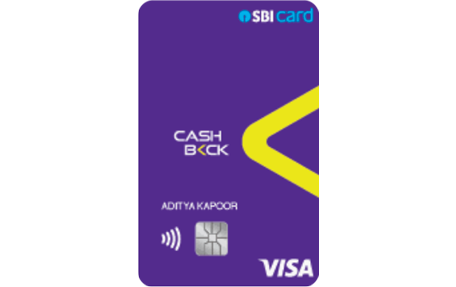
Who this card is for
We'd hand this card to any salaried or self-employed Indian earning Rs 3 lakh or more whose monthly spend is 70% online. That's Swiggy, Zomato, Amazon, Flipkart, BigBasket, IRCTC, and the rest. The sweet spot is someone spending Rs 25,000 to Rs 1 lakh a month online across many merchants. If you live on one or two merchants like Flipkart only, a co-branded card will still beat this. But for generalists who refuse to juggle cards, there's no simpler 5% card in India right now.
What you earn
The structure is clean on paper: 5% cashback on eligible online spends, 1% on offline. The reality after April 1, 2026 is narrower than the marketing implies. SBI restructured the cap into a Rs 2,000/cycle online sub-cap, a Rs 2,000/cycle offline sub-cap, and a Rs 4,000 aggregate ceiling. The binding constraint for almost every user is the Rs 2,000 online sub-cap, which maxes out at Rs 40,000 of eligible online spend per cycle.
The exclusion list is substantial and grew on April 1. Cashback does not accrue on wallet loading, rent and property management, utility bills, insurance, jewellery, school and educational services, gift and novelty shops, railways, quasi-cash, standing instructions, Flexipay, merchant EMI, fuel, and â new from April 2026 â digital gaming, tolls, and government-related transactions. These are not edge cases; together they cover a meaningful share of a typical urban household's online spend.
Compared to HDFC Millennia, which caps 5% at Rs 1,000/cycle on four hero merchants (Amazon, Flipkart, Myntra, Sony LIV) and pays 2.5% on broader online above that cap, SBI Cashback now offers twice the absolute ceiling but a harder overflow cliff. For households whose online spend concentrates on the four Millennia partners, the cards are roughly tied on cashback yield and Millennia wins on the 8 domestic lounges that SBI lacks. For households whose online spend concentrates on non-Millennia partners (Tata CLiQ, BookMyShow, MakeMyTrip), SBI retains a margin of roughly Rs 6,000â10,000 a year.
Cashback posting remains one of the cleaner experiences in the Indian card market. SBI credits cashback directly against your statement balance in the next billing cycle, no manual redemption required. That simplicity is real value â HDFC Millennia's CashPoints redemption is friction the SBI card avoids â and it partially offsets the post-devaluation cap reduction. For anyone new to credit cards, that simplicity continues to matter.
| Category | Rate | Detail |
|---|---|---|
| online shopping | 5% | 5% cashback on eligible online spends (excludes wallet loading, rent, utility, insurance, jewellery, education, gift, railways, quasi-cash, gaming, tolls, government â Rs 2,000/cycle online sub-cap) |
| offline | 1% | 1% cashback on offline spends (Rs 2,000/cycle offline sub-cap) |
| Default cashback rate | 1% | All other eligible spends |
| Monthly cashback cap: ₹4,000 | ||
Getting the most out of the ₹4,000 monthly cap
The ₹4,000 monthly cashback cap means your benefit from this card maxes out once you spend ₹80,000 in the accelerated category each month. At 5% cashback on online shopping, that is the breakeven point where every additional rupee earns less.
In practice, if you push more than ₹80,000 of online shopping spend through this card in a calendar month, the rupees above the cap drop to the default cashback rate of 1%. The card is at its strongest when your online shopping spending lines up close to the cap rather than blowing past it. If your monthly spend in this category is consistently double the breakeven, a second card with a separate cap is usually the better setup.
What it costs
The joining fee is Rs 999 and the annual fee is also Rs 999, both plus GST. Waiver triggers at Rs 2 lakh of annual spend, which is about Rs 16,700 a month. For anyone in the target audience, crossing that is automatic by April or May.
Is this card free in practice? For most salaried users yes, but the margin has narrowed. If you hit the new Rs 2,000 monthly online cashback sub-cap even three or four times a year, you've recovered the Rs 999 annual fee. There's a 1% fuel surcharge waiver on transactions from Rs 500 to Rs 3,000 capped at Rs 100 per cycle, a slightly narrower range than what HDFC Millennia offers but still covers most petrol pump visits.
| Joining fee | ₹999 |
| Annual fee | ₹999Waived on annual spend of INR 2,00,000+ |
The honest balance sheet
What works
- Flat 5% cashback on eligible online spends across a broad merchant list (excluding wallet, rent, utility, insurance, fuel, gaming, tolls, and a few other categories)
- Rs 2,000 monthly online cashback sub-cap is twice HDFC Millennia's Rs 1,000 cap, though the overflow behaviour above the cap is harsher
- Annual fee waiver at just Rs 2 lakh of spend, easy for most urban salaried users to hit
- 1% cashback on offline spends means the card is still useful in a tier-2 kirana shop
- Direct credit of cashback to the card statement, no points to redeem manually
What it costs you
- Zero lounge access, which is unusual at this annual fee. Skip this card if you travel domestically four or more times a year
- No welcome bonus or milestone rewards, so the card is pure cashback with no upside on heavy spending
- Excludes rent, utility bill payments, wallet loads and some fuel transactions from the 5% rate
- Fuel surcharge waiver only on transactions Rs 500 to Rs 3,000, narrower than competitors
- April 2026 devaluation halved the online cashback ceiling to Rs 2,000/cycle (Rs 40,000 spend) and added three new exclusion categories (gaming, tolls, government), shrinking the card's effective value for heavy-online households