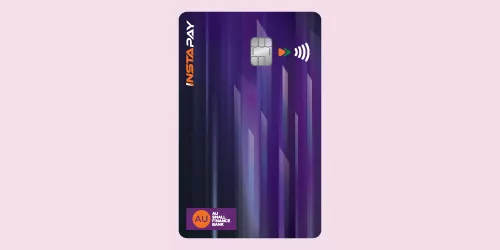
AU Bank InstaPay Credit Card Review
AU Small Finance Bank
By Vikram Warialani, Editor-in-Chief
PickMyCard may earn a commission on this referral. Our recommendations stay independent. Learn more
Quick Verdict
The ₹100 monthly cashback ceiling defines this card: a UPI companion for existing AU Bank credit card holders, not a primary earner.
Who Should Get This Card
The AU InstaPay card has a narrow mandate: earn something on the UPI transactions an existing AU Small Finance Bank credit cardholder is already making. Its eligibility requirement locks out everyone who is not already in the AU Bank credit card ecosystem, so the starting audience is pre-defined. Within that pool, the card suits people who consistently run grocery runs, dining bills, and pharmacy purchases through UPI scan-and-pay at physical merchants, paying QR codes at the local kiranas and independent restaurants that do not take card swipes. Monthly spend of ₹10,000 or more across the four qualifying categories will hit the ₹100 cashback ceiling each cycle. For cardholders whose UPI use skews toward bill payments, rent, or online transactions, most of their spend falls outside the qualifying categories and the card returns little. One practical constraint: InstaPay is a virtual card only. No plastic is issued. Cardholders who need a physical card for tap-to-pay or online checkout requiring a card-on-file should keep their primary AU card active for those use cases.
Rewards and Cashback in Detail
The card earns 1% cashback on UPI transactions made at four merchant categories: dining, departmental stores, grocery and supermarkets, and pharmacies. Every qualifying transaction must clear ₹200 in value. A ₹350 grocery run earns ₹3.50. A ₹600 pharmacy bill earns ₹6. Route ₹10,000 through qualifying UPI spend in a month and the statement cycle cap of ₹100 is reached, after which further qualifying spend earns nothing until the next cycle.
That ceiling is the most important number on the card. Annualised, the maximum return is ₹1,200, available only to cardholders who consistently hit the ₹10,000 monthly qualifying threshold. A household spending ₹6,000 on groceries, ₹2,500 on dining, and ₹2,000 at the pharmacy each month will cross the qualifying threshold and cap the cashback every cycle without trying. Conversely, a cardholder whose grocery bill runs to ₹3,000 monthly and whose other qualifying spend is sporadic will earn ₹30 in most months, a return that sits below the ₹99 redemption fee charged per cashback withdrawal.
Outside those four categories, the cashback rate is zero on all UPI spend. Telecom, utilities, online shopping, rent, and peer-to-peer transfers all earn nothing. Non-UPI card swipes earn nothing either. Built around one use case, UPI scan-and-pay at physical merchants where a QR code is the dominant payment surface, the card excludes everything else by design.
Petrol payments get one additional perk: a 1% fuel surcharge waiver applies on transactions between ₹400 and ₹5,000 at any fuel station. The waiver is itself capped at ₹100 per billing cycle. Both UPI and card-swipe transactions at fuel stations qualify, making fuel the only non-category route to any return on this card.
| Category | Cashback Rate | Cap / Details |
|---|---|---|
| Dining | 1% | 1% cashback on UPI transactions at dining establishments (min ₹200 per transaction) |
| Departmental Stores | 1% | 1% cashback on UPI transactions at departmental stores (min ₹200 per transaction) |
| Grocery & Supermarkets | 1% | 1% cashback on UPI transactions at grocery stores and supermarkets (min ₹200 per transaction) |
| Pharmacy | 1% | 1% cashback on UPI transactions at pharmacies (min ₹200 per transaction) |
Monthly cashback cap: ₹100
Getting the Most Out of the Monthly Cap
The ₹100 monthly cashback cap means your benefit from this card maxes out once you spend ₹10,000 in the accelerated category each month. At 1% cashback on Dining, that is the breakeven point where every additional rupee earns less.
In practice, if you push more than ₹10,000 of Dining spend through this card in a calendar month, the rupees above the cap drop to the default cashback rate of 0%. The card is at its strongest when your Dining spending lines up close to the cap rather than blowing past it. If your monthly spend in this category is consistently double the breakeven, a second card with a separate cap is usually the better setup.
What Does It Actually Cost
Joining and annual fees are zero, unconditionally. No minimum spend target to clear the fee, no first-year waiver that expires, no annual renewal cost to recalculate. Its entire cost-benefit calculation rests on the cashback side, which makes the ₹100 monthly cap the real number to evaluate rather than any fee math.
One structural note: InstaPay's credit limit is shared with the existing AU Small Finance Bank primary card. The bank does not extend a fresh credit line on approval. Cardholders working close to their primary card's limit need to account for InstaPay spend in the same pool.
The finance charge rate is 3.75% per month, which annualises at 45%. Late payment charges are levied at 15% of outstanding balance, floored at ₹10 and capped at ₹1,300. Reward redemption costs ₹99 plus GST per request. For cardholders redeeming small accumulated balances, that redemption charge can equal or exceed a single month's cashback, so collecting over three or four months before redeeming makes more sense than cashing out each statement cycle.
Carrying a balance at 45% annualised erases cashback earnings quickly. One month of balance carry at 3.75% on ₹5,000 costs ₹187, roughly two months of maximum cashback. Zero-fee benefit is real only for cardholders who pay the statement balance in full each month. An up-to-48-day interest-free window is a reasonable runway, and full-payment discipline is the only mode in which this card makes financial sense.
| Joining Fee | FREE |
| Annual Fee | FREE |
Pros
- Genuinely lifetime free with no spend conditions attached
- 1% UPI cashback at physical merchant categories that most credit cards exclude from rewards
- Fuel surcharge waiver on ₹400-₹5,000 transactions
Cons
- Monthly cashback capped at ₹100, limiting annual return to ₹1,200 at most
- Available only to existing AU Small Finance Bank primary credit cardholders
- Virtual card only: no physical plastic issued
- Zero cashback on card swipes and on UPI categories outside the four named ones
- No lounge access, welcome offer, or milestone rewards
Our Verdict
The case for holding this card is specific: you are already an AU Small Finance Bank credit cardholder who pays UPI at physical merchants in the four qualifying categories regularly, and you want to earn something on that spend at zero annual cost. Within those parameters, the card does what it says.
The virtual-only format is worth noting before applying. InstaPay issues no plastic. Setup requires the AU 0101 app and linking the RuPay credit card to a compatible UPI app, which is a straightforward process for those comfortable with digital-first banking but an additional step compared to receiving a physical card. Cardholders who prefer a physical card as a backup payment method will need to keep the primary AU card in the wallet regardless.
For everyone outside that narrow brief, the return does not justify the application. The ₹100 monthly cap and the restricted eligibility make it a poor choice as a standalone card for a new applicant even if AU Bank were to open it to the broader public. Kiwi offers 1.5% on UPI scan-and-pay at any merchant category, with a monthly cap pegged to credit limit rather than a hard rupee ceiling, at the same zero-fee cost. A reader without an existing AU Bank card who wants UPI-linked cashback should start with Kiwi.
Two points in the InstaPay's favour. First, UPI-linked credit cards remain rare in 2026. Banks have been reluctant to extend rewards to UPI spend because the interchange economics are unfavourable. A card that earns 1% at the grocery store, the pharmacy, and the neighbourhood restaurant where QR is the only payment surface adds genuine value to that specific UPI flow. Second, the zero-fee structure means there is no holding cost and no incentive to close the card when it earns little in a slow month.
Hold it as the companion card it was built to be, direct UPI spend at the four qualifying categories toward it, and collect the annual ₹1,200 at no cost. Do not close it in thin months.
2.8 / 5
PickMyCard rating
Ready to apply?
Get the AU Bank InstaPay Credit Card through our referral link.
PickMyCard may earn a commission when you apply through our links. This does not affect our recommendations or rankings.