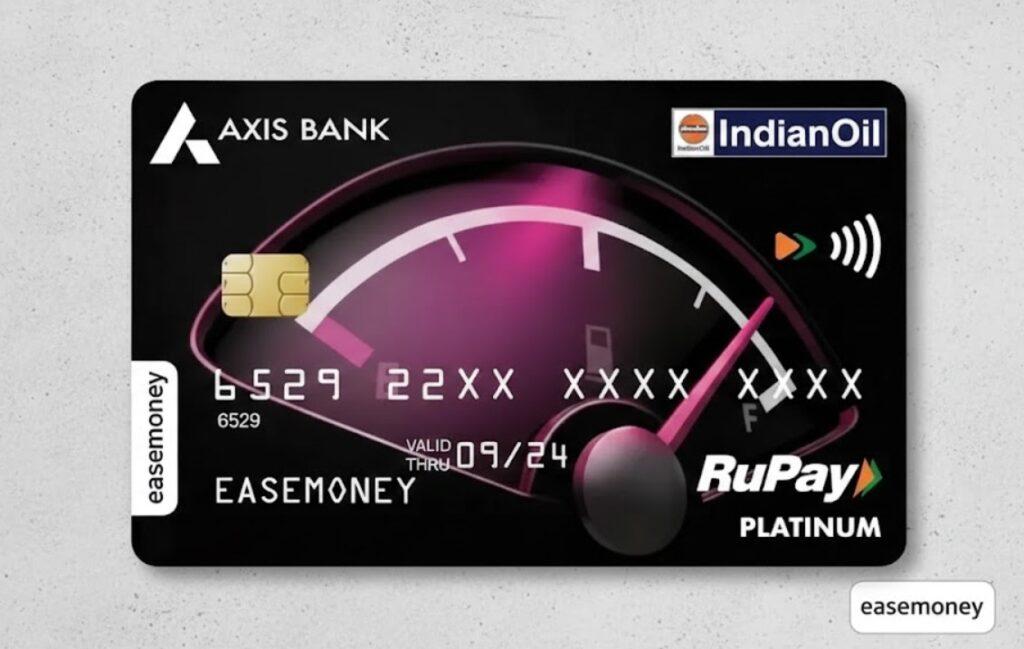
Should you pick the Visa or the RuPay variant of the IndianOil Axis Bank Credit Card? The fuel rewards are identical at 20 EDGE Reward Points per INR 100, the annual fee sits at INR 500 for both, and the waiver gate is the same INR 3.5 lakh. Three quiet differences change the answer for most readers: UPI support on the RuPay variant, the welcome benefit structure, and the online shopping accelerator on the Visa side.
Quick verdict: the RuPay variant wins for the cardholder who pays heavily through UPI on QR codes at neighbourhood pumps, since it earns the full 20-points rate on UPI-routed IndianOil transactions. The Visa variant edges ahead for the cardholder whose card sees INR 8,000+ of monthly online card spend, since the 1% online accelerator is unique to that variant.
What Each Card Earns on Fuel
Both variants pay 20 EDGE Reward Points for every INR 100 spent at IndianOil pumps. Each Reward Point is worth INR 0.20, which works out to 4% value-back on fuel. Add the 1% surcharge waiver and the headline rate hits 5%.
The accelerated rate is capped. Axis pays 20 points per INR 100 only on the first INR 5,000 of monthly IndianOil spend, equivalent to 1,000 points or INR 200 of fuel value-back per month. Spend beyond that earns the default 1 point per INR 100, dropping the rate to 0.2%.
Redemption is straightforward. Reward Points convert to fuel discount at IndianOil pumps, statement credit, or items in the Axis catalogue. The fuel-redemption pathway delivers the full INR 0.20 per point. Statement credit converts at INR 0.20 too. Catalogue redemption is hit and miss, with many items pricing points well below this rate.
Where the Variants Diverge
| Feature | IndianOil Axis Visa | IndianOil Axis RuPay |
|---|---|---|
| Network | Visa | RuPay |
| Annual fee | INR 500 | INR 500 |
| Waiver gate | INR 3.5 lakh | INR 3.5 lakh |
| Fuel rate at IndianOil | 20 points per INR 100 | 20 points per INR 100 |
| Online shopping rate | 5 points per INR 100 | Not listed |
| UPI payments | Not supported | Supported |
| Welcome benefit | 1,250 points on first fuel txn | 100% cashback up to INR 250 over 30 days |
| NCMC transit support | No | Yes |
| International acceptance | Wide | Limited outside India |
On the Visa variant, online shopping earns 5 EDGE Reward Points per INR 100, a 1% value-back rate. The RuPay variant does not list this online accelerator. For a household that spends INR 8,000 a month online, the Visa returns roughly INR 960 a year more than the RuPay on shopping alone.
On the RuPay variant, the welcome benefit is generous in a different way. New cardholders earn 100% cashback up to INR 250 on all IndianOil fuel spends within the first thirty days, paid as statement credit. The Visa variant's welcome benefit is up to 1,250 EDGE Reward Points on the first IndianOil fuel transaction, equivalent to INR 250 in fuel value. Headline numbers match, but the RuPay variant rewards repeat fills in the first month while the Visa variant pays only on the first transaction.
The biggest practical difference is UPI. RuPay credit cards link to UPI apps, letting cardholders scan a QR code at any IndianOil pump that accepts UPI and earn the full 20-points rate on the transaction. The Visa variant only earns on swipes, taps, and online card payments. For drivers who pay through PhonePe or Google Pay at smaller IndianOil outlets, the RuPay variant captures rewards the Visa simply cannot.
The UPI Advantage in Real Numbers
For a typical Indian commuter paying INR 4,000 a month on IndianOil fuel, with three of those four thousand routed through UPI scans at neighbourhood pumps, the Visa variant earns rewards on only INR 1,000 of that spend, the chip-and-PIN portion. That is 200 points a month, or INR 40 of monthly fuel value-back.
The same commuter on the RuPay variant earns on the entire INR 4,000, picking up 800 points a month, or INR 160 of fuel value-back. That is INR 1,440 a year of additional reward earn purely from UPI eligibility, which more than triples rewards on a typical fuel pattern.
If your IndianOil pumps are all card-accepting forecourts in metros, the UPI gap shrinks to zero and the Visa variant's online accelerator catches up. The choice flips on usage pattern, not on card design.
The Fee Math
Both variants charge INR 500 as joining and INR 500 each year on renewal, waived at INR 3.5 lakh of total annual spend. Roughly INR 30,000 a month of card spend gets the fee back to zero, which is reachable on a household with combined card use across utilities, groceries, and routine bills.
For a fuel-only user putting INR 4,000 a month at IndianOil, monthly fuel rewards run at INR 200 of fuel value-back including the surcharge waiver. That is INR 2,400 a year of fuel rewards, comfortably ahead of the INR 500 fee even before any spend-waiver kicks in. The card's fuel maths makes sense for a household putting at least INR 2,500 a month at IndianOil pumps and scales linearly until the INR 5,000 monthly fuel cap binds.
Who Should Get Which
Pick the IndianOil Axis RuPay variant if you fill up at neighbourhood IndianOil pumps where UPI is the dominant payment, your monthly online card spend is under INR 5,000, and you want the NCMC-enabled card to use on metro and bus systems. The first-month welcome benefit also rewards heavier early use, which suits new card setups that aim to push fuel through the card right away.
Pick the IndianOil Axis Visa variant if your fuel pumps are mostly highway-access or branded forecourts that take card swipes cleanly, you spend INR 8,000 or more a month online, and you book international travel where Visa's overseas acceptance helps. The Visa variant's online accelerator pays back roughly INR 960 a year on regular online shopping, which usually exceeds the UPI rewards lost on a moderate fuel spend.
Drivers split between modes can hold both variants, since the annual fee is the same and Axis allows two cards on the same primary account. But for a single-card cardholder choosing one, the RuPay variant tends to be the smarter pick at this fee level. UPI scans are now the default at most Indian IndianOil pumps, and the first-month welcome benefit alone covers nearly half the first-year fee.
Run your own numbers
Put the Visa and RuPay variants side by side for the current fees and fuel reward rates.
Comparing across issuers instead of across networks? RBL IndianOil vs IndianOil XTRA runs the same fuel maths on RBL's two co-branded cards, including the spend at which the higher fee pays for itself.
Sources
Card devaluations, reward maths, and rate changes the day they land.
Follow on X
Reader comments
No comments yet. Share your experience with this card below — the first useful comment helps every reader after you.
Comments are moderated before they appear. Share your real experience with a card — what worked, what didn't, what the bank told you. We don't publish promotional content, referral links, or personal financial details. Keep it useful for other readers.