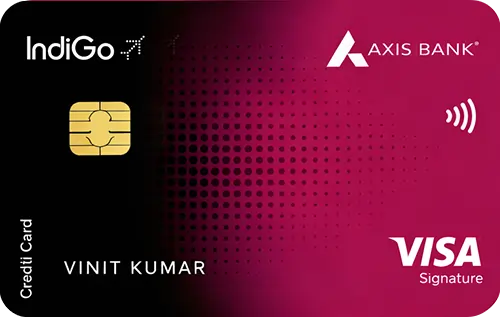
Who this card is for
The Premium is the second rung of the IndiGo-Axis co-branded range, and the pricing makes the target user clear: this is not a card for the occasional IndiGo traveller. At ₹5,000 a year, it asks for a commitment that only a frequent and reasonably heavy spender can justify. The card returns most of that cost upfront through a 5,000 BluChip welcome voucher and a 6E Eats meal benefit, but the real value-building mechanism is the four-tier milestone system that releases 5,000 BluChips at each of ₹2 lakh, ₹5 lakh, ₹8 lakh, and ₹12 lakh of annual spends.
A cardholder clearing all four milestones earns 20,000 milestone BluChips plus 5,000 from the annual renewal voucher: 25,000 BluChips from bonuses alone, worth roughly ₹12,500 in IndiGo fare value before the per-rupee earn starts. That picture belongs to a specific person: the commuter or frequent business traveller who books IndiGo several times a month, routes meaningful monthly spends through the card, and wants the Priority Pass international lounge access that the standard IndiGo card does not offer.
For someone whose travel is split across carriers, the IndiGo lock-in at ₹5,000 is a hard ask. The base IndiGo Axis card and this Premium sit at very different price points, and that gap is the first question to answer. The standard card serves the regular-but-light IndiGo flyer. The Premium is for the flyer whose annual IndiGo spend is high enough to make the milestone structure work.
What you earn
The headline difference between the Premium and the standard variant is the earn rate on IndiGo: 7 BluChips per ₹100 versus 3. On a ₹10,000 IndiGo booking, the Premium earns 700 BluChips (roughly ₹350 in fare value) against the standard card's 300 (₹150). That gap compounds fast across a year of regular IndiGo bookings. Grocery and hotel spends return 3 BluChips per ₹100, and all other eligible spends earn 2 BluChips per ₹100, making the Premium at least moderately competitive on general spend in a way the standard card's 1-BluChip base is not.
The milestone structure is where the arithmetic shifts decisively. Each of four annual thresholds (₹2 lakh, ₹5 lakh, ₹8 lakh, ₹12 lakh) releases a separate 5,000 BluChip voucher. A cardholder spending ₹1 lakh a month (₹12 lakh annually) clears all four and earns 20,000 milestone BluChips, worth approximately ₹10,000 in IndiGo fare value. Add the 5,000-BluChip annual renewal voucher and the base per-rupee earn on ₹12 lakh of spends (weighted average of roughly 2–3 BluChips per ₹100 across category mix) and the annual return picture is genuinely strong for committed IndiGo loyalists.
The 5,000 BluChip welcome voucher plus a 6E Eats in-flight meal voucher on joining fee payment is a solid first-year boost: the voucher alone recovers around ₹2,500 in fare value, offsetting half the ₹5,000 joining fee before any spending. The same renewal benefit repeats every year.
BluChip redemption remains IndiGo-specific. The best use is against IndiGo ticket prices; partial-fare offsets are available, but BluChips are not transferable to other programmes or easily cashed out elsewhere. This narrows the card's appeal sharply to IndiGo loyalists, but for that audience the yield per rupee is among the stronger rates in India's co-branded travel card space.
| Category | Rate | Detail |
|---|---|---|
| IndiGo channels | 7× | 7 IndiGo BluChips per ₹100 on all IndiGo channels (website, app, call centre, airport counter) |
| Grocery & Hotels | 3× | 3 IndiGo BluChips per ₹100 on grocery and hotel spends |
| Default earn rate | 2× | All other eligible retail spends |
The fee structure
The ₹5,000 plus GST fee applies to both the joining charge and annual renewal, and there is no spend-based waiver on record. The fee is roughly six times the standard IndiGo Axis card's ₹799, which means the Premium has to earn significantly more to justify the switch.
The maths is straightforward. The 5,000 BluChip renewal voucher recovers about ₹2,500 in IndiGo fare value, leaving a net fee burden of roughly ₹2,500 before any spending. Clearing the first milestone (₹2 lakh of annual spend) returns another 5,000 BluChips (₹2,500 in fare value), bringing the effective net cost to near zero. At ₹5 lakh or more of annual spend, the card operates in net-positive territory from fee coverage alone, and the per-rupee earn compounds on top.
The fee becomes harder to justify below the first milestone. Someone spending ₹1–1.5 lakh a year gets the 5,000 renewal voucher but misses the second milestone, which keeps the Premium at breakeven at best. The standard card at ₹799 would net-positive comfortably at that spend level. The inflection point is roughly ₹2 lakh of annual spend: clear that, and the Premium starts earning its keep over the standard variant.
| Joining fee | ₹5,000 |
| Annual fee | ₹5,000 |
Lounge access
Strengths and trade-offs
What works
- 7 BluChips per ₹100 on IndiGo channels, more than double the standard variant, returning roughly 3.5% in fare value on flight bookings
- 5,000 BluChip welcome and renewal voucher plus a 6E Eats meal benefit, recovering approximately ₹2,500 in fare value against the annual fee
- Four milestone tiers (₹2L / ₹5L / ₹8L / ₹12L) each releasing 5,000 BluChips, up to 20,000 milestone BluChips per year
- 2 domestic lounge visits per quarter (8 per year) and 2 Priority Pass international visits per year, covering the lounge access the standard card does not provide
- 2.5% forex markup, lower than the 3.5% on the standard IndiGo Axis card, for those who occasionally use the card internationally
What it costs you
- ₹5,000 annual fee with no spend-based waiver: the card breaks even only if the first ₹2 lakh milestone is cleared; poor value below that threshold
- BluChips are redeemable only within the IndiGo ecosystem: no transfer partners, no flexibility if flying patterns change to another carrier
- Priority Pass international access is capped at 2 visits per year, which is adequate only for the occasional international traveller