Correction (13 July 2026): an earlier version of this article read Jupiter Edge+'s ₹200 per-transaction cap as a limit on qualifying spend, and concluded a ₹3,000 order earns under 1%. It is a cap on the value earned: a ₹3,000 order earns about ₹200, or 6.7%. We have corrected this and updated the card's caps to the structure in force since 1 June 2026.
Both are lifetime free. Both run on RuPay. Both work on any UPI QR code across India. From that shared starting point, the two cards serve entirely different spending habits, and picking the wrong one means leaving several hundred rupees of cashback per month uncaptured.
This is not a close comparison. It is two cards designed for two different readers, and the right answer depends almost entirely on one question we will get to at the end.
What each card is actually built for
The Kiwi RuPay Credit Card is a UPI-first product. Its core proposition is paying 1.5% on scan-and-pay transactions at vendors most credit cards cannot reach: the kirana, the auto-repair workshop, the neighborhood grocery that accepts UPI but refuses card swipes. Issued through Yes Bank or AU Small Finance Bank, Kiwi earns on the spending that normally earns nothing.
There is an optional upgrade called Neon (₹999 plus taxes a year) that increases the rate at three spend milestones: 3% after ₹50,000 of qualifying annual UPI spend, 4% after ₹1 lakh, and 5% after ₹1.5 lakh. Neon also unlocks up to three complimentary domestic lounge visits per year, one released at each milestone. For a heavy UPI user running ₹10,000 to ₹15,000 a month through scan-and-pay, the Neon fee pays for itself before the highest tier.
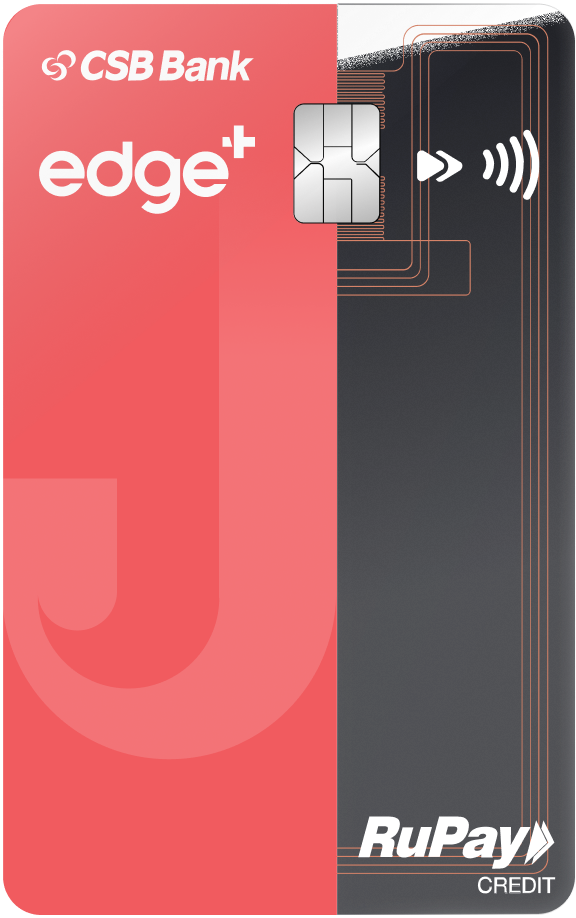
Jupiter Edge+ CSB Bank RuPay takes a different angle entirely. The headline is 10% cashback on Amazon, Flipkart, Myntra, Nykaa, Croma, Tata Cliq, and several other brand-name online retailers. The card is built for shoppers whose spend clusters on a short list of platforms. Its UPI functionality earns cashback, but UPI is secondary here, not the reason to hold this card.
Rewards breakdown
| Metric | Kiwi RuPay | Jupiter Edge+ CSB |
|---|---|---|
| Annual fee | ₹0 | ₹0 (but joining fee is ₹999, currently promo-waived) |
| UPI scan-and-pay rate | 1.5% | 1% |
| Online shopping rate | 0.5% | 10% as vouchers / 7% as statement credit (cap: ~₹200 of value per transaction) |
| Travel platforms | None | 5% on MakeMyTrip, EaseMyTrip, Yatra, Cleartrip |
| Monthly rewards cap | 1% of credit limit | 10,000 Jewels shopping (≈₹2,000) + 5,000 Jewels flights |
| Lounge access | None on base card | 1 visit per quarter on ₹90,000 quarterly spend |
| Fuel surcharge waiver | No | 1% waiver |
| Welcome benefit | None | Jio Hotstar subscription (₹1,499 value) |
| Rewards currency | Kiwis to bank account | Jewels (value varies by redemption type) |
Kiwi's monthly cap binds earlier than it looks. Kiwis are capped at 1% of your credit limit each month. A ₹2,00,000 credit limit means a ₹2,000 monthly ceiling on earned Kiwis. Most cardholders will not hit this, but if the issued limit is low (common on a fintech-issued first card), the cap arrives before you expect it.
Jupiter's per-transaction cap is a cap on what you EARN, not on what counts. This is worth stating plainly because it is widely misread — including in an earlier version of this article. The cap does not mean "only the first ₹200 of your order earns 10%". It means "you can earn up to about ₹200 of value on any one transaction".
So a ₹1,000 Flipkart order earns the full 10% — around ₹100. A ₹3,000 Amazon order earns the cap, about ₹200, which is an effective 6.7%, not the sub-1% that the spend-cap reading would imply. The rate only starts degrading on orders above roughly ₹2,000, and even then it degrades gently.
The honest summary: Jupiter's shopping rate is good, and better than most write-ups (ours included, until now) have given it credit for. What actually erodes it is the redemption currency — see below.
Jupiter's Jewels problem
Jupiter Edge+ pays rewards as Jewels, not rupees, and this is where the card actually loses.
Since 1 June 2026 the shopping category earns 50 Jewels per ₹100 spent. What a Jewel is worth then depends entirely on how you cash it out:
- ₹0.20 per Jewel — vouchers, digital gold, Jupiter Flights, Jupiter Store. This preserves the headline 10%.
- ₹0.14 per Jewel — statement credit, bill payments, cash. This drops you to 7%.
That is a 30% haircut for the crime of wanting your cashback as money. Voucher-locked rewards also carry redemption friction and are worth less than cash to most people, so treat 7% — not 10% — as the number to plan around unless you genuinely spend on gold and vouchers.
The caps moved to Jewels in the same June 2026 change: 10,000 Jewels per billing cycle on shopping (about ₹2,000 of value), 3,000 per merchant, 1,000 per transaction. Kiwi has no currency conversion risk at all.
Kiwi has no currency conversion risk. Kiwis redeem directly into the linked bank account at a fixed ₹0.25 per Kiwi. The 500-Kiwi minimum (₹125 minimum redemption amount) is the only structural constraint. There is no moving conversion rate to track and no devaluation history to account for.
UPI on both cards: a different meaning each time
Both cards run on RuPay's UPI credit-card infrastructure, but their intended role in a day of spending differs.
On Kiwi, scan-and-pay UPI is the primary earn driver. The 1.5% rate applies at any merchant accepting UPI, the long tail of vendors where direct card swipes do not work. The exclusion list covers fuel, utilities, rent, telecom, insurance, education, jewellery, and government services, matching what most credit cards exclude. Within those carve-outs, Kiwi earns on everyday small-ticket spending that most other cards skip entirely.
On Jupiter Edge+, UPI earns 1% at the base rate against a monthly ₹1,000 sub-cap. The 10% shopping rate does not apply on UPI transactions; that rate is for direct card or net-banking purchases at the named brand partners only. Cardholders planning to use Jupiter Edge+ primarily through UPI will find the 1% rate unremarkable compared to Kiwi and other entry-level options.
One question that decides it
Where does the bulk of your discretionary spending actually go?
If the answer is Amazon, Flipkart, Myntra, or the other listed Jupiter partners, Jupiter Edge+ earns far more than Kiwi on that portion of spend — and you do not need to keep your orders small to get it. The 7% effective rate on statement credit (or 10% as vouchers) runs well ahead of Kiwi's 0.5% collect-mode rate for online shopping. Add the ₹1,499 Jio Hotstar welcome benefit and the lounge access if quarterly spend clears ₹90,000, and the card earns its place in the wallet.
If the answer is everyday offline and neighborhood spending, restaurants without a swipe terminal, local service vendors, anything paid via a UPI QR at a small merchant, Kiwi is the better instrument. No other lifetime-free credit card in India currently pays 1.5% on this category as a base rate. The Neon upgrade extends that to 5% at ₹1.5 lakh of qualifying annual spend, which materially changes the economics for anyone running consistent monthly UPI volumes.
The case for holding both is worth considering. Jupiter Edge+ covers the online-shopping slice at 7% effective where it applies. Kiwi covers the daily UPI spending that fills the rest of the month. Combined annual cost remains ₹0. The only cost is managing two cards; the payoff is a higher combined earn rate than either card delivers alone.
The crossover: how much UPI does it take to beat one Amazon order?
These two cards do not compete on the same spending, which is why "which is better" has no answer until you put a ratio on it. Here is the ratio.
Jupiter earns 7% on partner shopping (taking statement credit, the honest number). Kiwi earns 1.5% on UPI scan-and-pay. Setting the two equal:
1.5% × (UPI spend) = 7% × (partner shopping spend) UPI spend = 4.7 × shopping spend
So every ₹1,000 a month you put through Amazon or Flipkart on Jupiter takes about ₹4,700 a month of UPI scan-and-pay on Kiwi just to draw level. If you insist on redeeming Jupiter's Jewels as vouchers at the full 10%, the ratio widens to 6.7× — roughly ₹6,700 of UPI per ₹1,000 of shopping.
Run that against your own month. If you spend ₹8,000 at partner merchants, Kiwi would need ₹37,600 of scan-and-pay UPI to match it — which is a lot of chai and kirana. Most people do not get there, and for them Jupiter earns more.
But the ceilings flip the answer at the top. Jupiter's shopping bucket caps at 10,000 Jewels a cycle, which it hits at ₹20,000 of partner spend a month — beyond that, additional shopping earns nothing extra in that category. Kiwi's cap is 1% of your credit limit, so on a ₹2 lakh limit it runs to ₹2,000 a month. Past ₹20,000 of monthly partner shopping, Jupiter's marginal rate collapses and Kiwi's does not.
The genuinely correct answer for most readers is to hold both. Both are free to keep. Jupiter takes the online-shopping slice at 7%; Kiwi takes the UPI spending that fills the rest of the month at 1.5% — spending that most credit cards cannot reach at all. There is no crossover you need to solve if you are not forced to choose.
One caveat before you treat Jupiter as free: the ₹999 joining fee is only promotionally waived, not permanently. Check it is still ₹0 on the day you apply.
Run your own numbers
The 4.7x ratio above assumes an average redemption choice and no cap binding. Yours may differ. Put Kiwi and Jupiter Edge+ side by side to see the fees, caps, and reward rates in one table, then plug your own monthly UPI and online-shopping figures into the ratio.
Other lifetime-free head-to-heads worth reading: HDFC Millennia vs SBI Cashback for the cashback pair most people compare next.
Sources

Card devaluations, reward maths, and rate changes the day they land.
Follow on X
Reader comments
No comments yet. Share your experience with this card below — the first useful comment helps every reader after you.
Comments are moderated before they appear. Share your real experience with a card — what worked, what didn't, what the bank told you. We don't publish promotional content, referral links, or personal financial details. Keep it useful for other readers.