
Most "new credit cards launched in 2026" lists this year are recycling old cards. A card that launched in December 2025, or one Axis Bank quietly revised in January, gets rediscovered by an aggregator and reprinted as news. We checked every name doing the rounds against issuer press releases, official product pages, and our own card database, and most of them fell out.
Exactly three survived that check. Here is what actually launched this year, with the date each one launched and what it costs to hold.
At a Glance: The Three Confirmed Launches
| Card | Issuer(s) | Launched | What it costs | What it pays |
|---|---|---|---|---|
| Google Pay Flex (SBI Card edition) | SBI Card, on RuPay and Visa | 29 July 2026 | ₹499 + tax, waived on ₹1,00,000 annual spend | 0.6%–1.6% of UPI spend on PickMyCard's own calculation*; doubling mechanic unconfirmed |
| Paisa+ | SBM Bank India, distributed by Paisabazaar | 25 June 2026 | Free joining; ₹499 + GST annual, waived on ₹50,000 spend | 1%–1.5% cashback, scaled to the backing FD |
| Kiwi (PNB edition) | Punjab National Bank, joining Yes Bank and AU SFB | Around 22 April 2026 | ₹0 joining, ₹0 annual | 0.5% base; 1.5% on UPI scan-and-pay |
The Flex-SBI 0.6%–1.6% figure is PickMyCard's own calculation, assuming ₹30,000 of eligible monthly UPI spend and no confirmed doubling. It is not a rate SBI Card has published.
Google Pay Flex Adds an SBI Card Edition
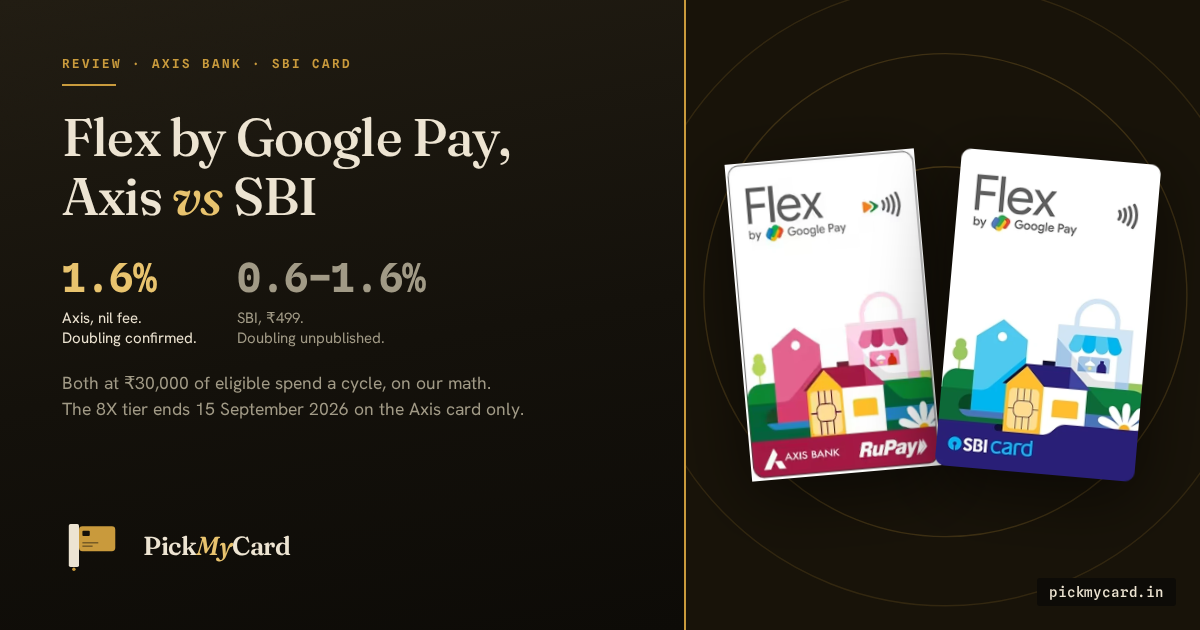
Feature. Axis Bank issued the first Flex by Google Pay card in December 2025. SBI Card followed on 29 July 2026, putting a second issuer behind the same Stars currency, the same spend thresholds, and the same monthly earning cap, on both RuPay and Visa.
Caveat. The two issuers are not identical products wearing one badge. Axis Bank's card is nil-fee, and Google has confirmed that crossing a spend threshold doubles the Stars already banked that cycle. SBI Card's version charges ₹499 plus tax, waived only on ₹1,00,000 of annual spend, and SBI Card has not published whether the same doubling rule applies. That gap turns a clean 1.6% headline rate into a range of 0.6% to 1.6%, on PickMyCard's own calculation, assuming ₹30,000 of eligible monthly spend and no confirmed doubling — SBI Card has not said which end applies.
Utility. For a reader choosing between the two, Axis Bank's edition wins on the numbers we can check. The SBI Card edition earns its place only for someone already banking with SBI Card, or waiting to see whether the doubling rule eventually gets confirmed. Our full comparison of both editions breaks down the UPI exclusions and the redemption math in more depth than a launch summary needs.
SBM Bank and Paisabazaar's Paisa+
Feature. SBM Bank India and Paisabazaar launched Paisa+ on 25 June 2026, a secured credit card that asks for a fixed deposit instead of an income document or a CIBIL score. The minimum FD is ₹2,000, and the credit limit is fixed at 90% of whatever is deposited.
Caveat. Cashback scales with the size of the FD, not with how much you spend. An FD above ₹10,000 earns 1.5% on online spends; anything from ₹2,000 to ₹10,000 earns 1%. The annual fee is ₹499 plus GST, waived only past ₹50,000 of yearly spend, and closing the card inside six months costs another ₹499 plus GST. None of that makes Paisa+ a poor product; it makes it a narrow one, built for exactly the reader it names.
Utility. This is not a card for anyone who could already qualify for an unsecured product. It is for someone with no credit file, or a damaged one, who wants a low-friction way to start building a score. Our launch coverage of Paisa+ has the full fee schedule and a direct comparison against Suryoday's Stable Money card, which competes for the same reader with a lower cashback rate but no annual fee at all.
Kiwi Adds Punjab National Bank as a Third Issuer

Feature. Kiwi's RuPay credit card, already issued through Yes Bank and AU Small Finance Bank, added Punjab National Bank as a third issuing partner in the spring of 2026. It is not a new card; it is the same lifetime-free product reaching PNB's existing account holders through their bank relationship, with no separate application to a new issuer required.
Caveat. The core mechanics are unchanged, and one of them catches people off guard: the monthly cap on Kiwi rewards is 1% of the card's credit limit, not a fixed rupee figure. On a starter credit line, that cap binds well before a heavy UPI spender expects it to. Fuel transactions earn nothing at all, and the base rate outside UPI scan-and-pay is a modest 0.5%.
Utility. For a PNB customer with no existing credit card, this is a genuine zero-fee entry point: 1.5% on UPI scan-and-pay against a joining and annual fee of ₹0. The optional ₹999-a-year Neon membership adds lounge visits and a richer cashback ladder for anyone spending past ₹50,000 a year, but the base card earns its keep without it.
How to Pick
Match the card to the gap it fills, not to the headline rate. If you already hold an Axis Bank account and want the strongest version of Flex, the Axis Bank edition beats SBI Card's on a confirmed mechanic. If you have no credit history and can park a small deposit, Paisa+ or Suryoday's card will get you a credit file faster than waiting on an unsecured approval. If you bank with PNB and want a UPI-linked card with no fee at all, the Kiwi tie-up needs nothing more than an existing PNB relationship.
None of the three replaces a strong rewards card for someone who already qualifies for one. They fill three specific gaps: a fee dispute between two issuers of the same product, a credit-building entry point, and a distribution expansion. Judge each on that basis, not on whether it made someone else's list of seven.
Disclosure: PickMyCard may earn a commission if you apply for the Kiwi or Suryoday Stable Money cards linked below. Neither Flex by Google Pay nor Paisa+ is monetised on this page; they are covered on editorial merit alone.
Sources
- Google Pay Flex (Axis Bank and SBI Card editions): terms confirmed in PickMyCard's own Flex by Google Pay review, sourced from Axis Bank, SBI Card, and Google's published mechanics, checked 4 August 2026.
- Paisa+: SBM Bank India's Key Fact Statement and the SBM/Paisabazaar launch announcement, as verified in PickMyCard's Paisa+ launch coverage, checked 9 July 2026.
- Kiwi's Punjab National Bank tie-up: PNB's own press communication on the Kiwi partnership (pnb.bank.in), cross-checked against Kiwi's card terms already verified in PickMyCard's card database, checked 6 August 2026.

Frequently asked
How many new credit cards actually launched in India in 2026?
As of early August 2026, PickMyCard can verify three against primary sources: the SBI Card edition of Google Pay Flex (29 July 2026), the SBM Bank India and Paisabazaar Paisa+ secured card (25 June 2026), and Punjab National Bank joining as a third issuer of the Kiwi RuPay card (around 22 April 2026). Aggregator lists naming five or seven cards are usually counting older cards that only received fresh press coverage this year.
Is the SBI Card version of Google Pay Flex worth it?
It costs 499 rupees plus tax, waived on 1 lakh rupees of annual spend. On PickMyCard's own calculation, assuming 30,000 rupees of eligible monthly UPI spend, it pays somewhere between 0.6% and 1.6%, depending on a doubling mechanic SBI Card has not confirmed either way. The Axis Bank version of the same card is fee-free and has that mechanic confirmed, which makes it the stronger of the two today.
What is the Paisa+ credit card and who is it for?
Paisa+ is a secured credit card from SBM Bank India and Paisabazaar, backed by a fixed deposit starting at 2,000 rupees. It is built for people with no credit history or a damaged one, not for anyone who could already qualify for an unsecured card.
Did Kiwi launch a new card with Punjab National Bank in 2026?
Not a new card. Kiwi's existing RuPay credit card added Punjab National Bank as a third issuing bank alongside Yes Bank and AU Small Finance Bank, giving PNB's UPI customers a route to the same zero-fee product.
Card devaluations, reward maths, and rate changes the day they land.
Follow on X
Reader comments
No comments yet. Share your experience with this card below — the first useful comment helps every reader after you.
Comments are moderated before they appear. Share your real experience with a card — what worked, what didn't, what the bank told you. We don't publish promotional content, referral links, or personal financial details. Keep it useful for other readers.