Flex by Google Pay is now two cards. Axis Bank issued the first in December 2025 and SBI Card the second on 29 July 2026, both on the same Stars currency, thresholds and monthly cap.
Branding is not the split. The Axis Bank card charges nil, and Google has confirmed that crossing a threshold doubles the Stars you have already banked that cycle. SBI Card's charges ₹499 plus tax and publishes no such rule, leaving its real rate at ₹30,000 a month between 0.6% and 1.6%. Axis Bank wins, on that one mechanic.
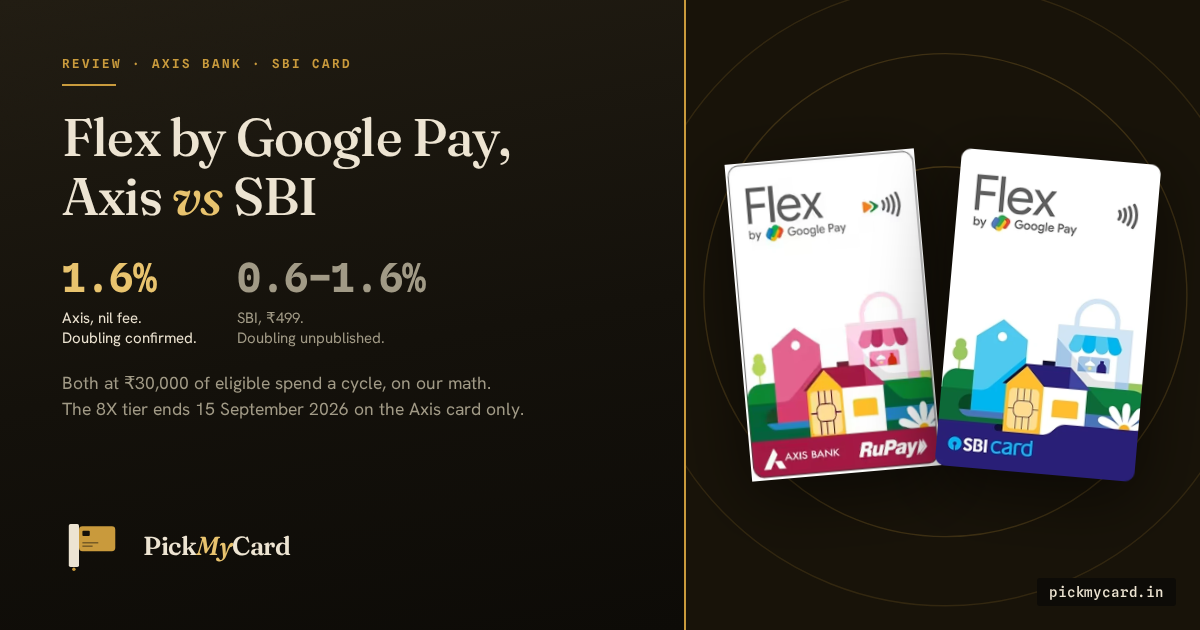
Flex by Google Pay: Axis Bank and SBI Card side by side
Flex by Google Pay from Axis Bank launched on 17 December 2025 on RuPay. The Google Pay Flex SBI Card followed on 29 July 2026, issued on both RuPay and Visa.
Commercial terms part them. Axis Bank charges nil on joining, annual and add-on fees. SBI Card charges ₹499 plus tax to join and ₹499 to renew, waived on ₹1,00,000 of annual spend.
SBI Card's own terms name no rupee figure, promising only a joining fee at the prevailing rate. The ₹499 comes from its MITC.
That waiver deserves a moment. ₹1,00,000 a year is about ₹8,333 a month, while the ladder only starts paying at ₹15,000. Anyone spending enough to want these rewards already spends enough to waive the fee, so the ₹499 filters out light users rather than costing the target one.
Welcome benefits differ, and SBI Card's is larger: a ₹500 Google Pay gift plus 500 Stars on paying the joining fee, against Axis Bank's up to ₹250 gift card plus 250 Stars inside 30 days.
| Flex by Google Pay (Axis Bank) | Google Pay Flex SBI Card | |
|---|---|---|
| Launched | 17 December 2025 | 29 July 2026 |
| Networks | RuPay only | RuPay and Visa |
| Links to UPI | Yes | RuPay variant only |
| Joining and renewal fee | Nil | ₹499 plus tax, waived on ₹1,00,000 annual spend |
| Star value | ₹1, expiring one year from issue | ₹1, expiring one year from issue |
| Earn cap | 1,500 Stars per cycle | 1,500 Stars per cycle |
| Booster thresholds | ₹15,000 and ₹30,000 of cycle spend | ₹15,000 and ₹30,000 of cycle spend |
| Doubles Stars already earned | Confirmed by Google Pay | Not published |
| 8X tier | Promotion ending 15 September 2026 | No end date published |
| Welcome benefit | Up to ₹250 gift card plus 250 Stars | ₹500 Google Pay gift plus 500 Stars |
| Extra perks | None published | 50% off Google AI Plus for a year, Pixel discounts |
What the Stars ladder actually pays
Flex by Google Pay from Axis Bank and the Google Pay Flex SBI Card both start at 1 Star per ₹500, or 0.2%, doubling to 2X, or 0.4%, once active on spend. Axis Bank runs 2X automatically in the joining cycle and SBI Card for the first two billing cycles, after which both need ₹100 of eligible spend in the previous cycle.
Google Pay's help page states that crossing a threshold on the Axis Bank card doubles the Stars already earned in the cycle and raises the rate onward. Work ₹30,000 through. Your first ₹15,000 at 2X earns 60 Stars. Crossing ₹15,000 doubles that to 120. The next ₹15,000 at 4X adds 120, for 240. Crossing ₹30,000 doubles it again: 480 Stars on ₹30,000 is 1.6%.
Those are our calculations, assuming eligible spend. The rate holds at ₹50,000 a month, worth 800 Stars, and stops at 1,500 Stars per cycle, so the cap binds at ₹93,750. The 8X tier behind it is an Axis Bank promotion ending 15 September 2026, after which the ceiling is 4X, worth 0.8%.
SBI Card has not published whether its thresholds double Stars already banked; its terms describe the milestone as a forward-looking rate change only. Run the same ₹30,000 both ways and the gap is close to threefold: 180 Stars, or 0.6%, without retroactive doubling, 480 Stars, or 1.6%, with it. Both are our calculations, and SBI Card has not said which.
That silence also punctures the ₹18,000 a year figure attached to the SBI launch: 1,500 Stars times twelve cycles. Collecting it means hitting the cap in twelve consecutive cycles, with no quiet month.
The spends neither card pays on
The two exclusion lists are near-identical, SBI Card's keyed to merchant category codes. Neither earns Stars on:
- rent and rental payments
- cash withdrawals and quasi-cash
- payments to financial institutions
- insurance premiums
- educational institutions and services
- government payments and fees
- wallet loads and wallet spends
- jewellery, watch, clock and silverware stores
- card fees and charges
- EMI-converted transactions
Excluded spend does not count toward the ₹15,000 and ₹30,000 thresholds either, so a renter can spend heavily and stay on the bottom rung.
Airport lounge access, a fuel surcharge waiver, a dining benefit and a milestone voucher are not offered on either card under the terms published so far.
RuPay, Visa, and the UPI trap
India's credit-card-on-UPI rails are open to one network: RuPay cards link to a UPI ID, Visa and Mastercard do not. RuPay's UPI exclusivity is why a Google product had to be built on RuPay.
Settled on the Axis Bank card, which is RuPay only. Not on the SBI Card version, issued on both RuPay and Visa: only the RuPay variant links to UPI. Picking Visa means giving up UPI-linked credit, the entire reason the product exists, so check the network before you submit.
Any QR code accepting UPI accepts a RuPay Flex card, and merchants under ₹2,000 pay no MDR.
Outside those QR codes the limits bite. NPCI rules restrict RuPay credit on UPI to merchant payments, so you cannot send money to a person with it, and your daily ceiling is ₹1 lakh, bounded by your credit limit. Both issuers price revolving credit at 3.75% per month, with a 3.5% forex markup, Axis Bank's published figure and SBI Card's standard schedule.
What you can get instead
PickMyCard has no application path for either Flex card and earns nothing if you take one. You apply direct through the issuer or in the Google Pay app. Neither publishes a minimum income or credit score.
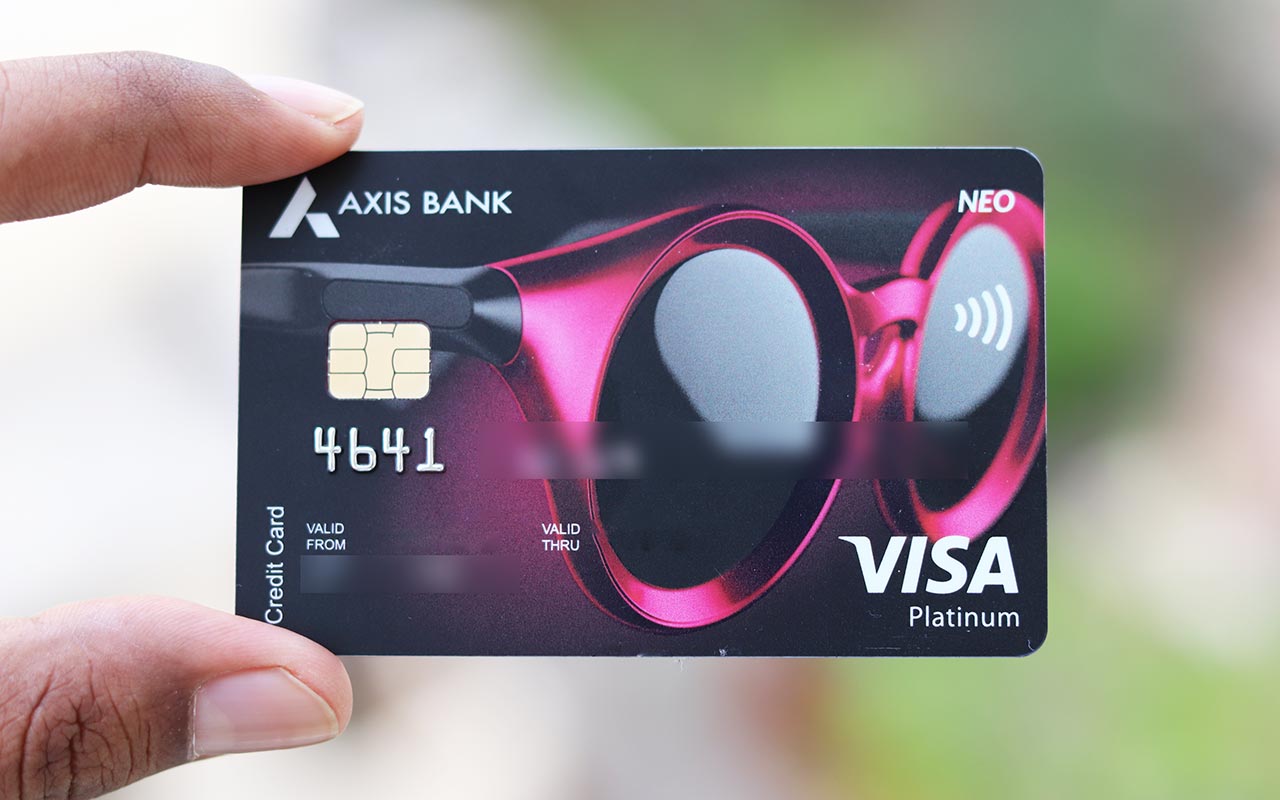
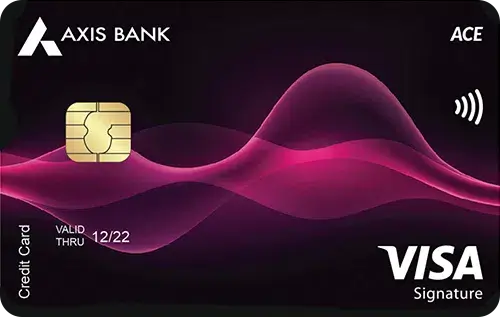
The alternative cards below are ones we may earn a commission on. Axis Neo RuPay charges no annual fee, pays 1% on UPI and 10% at Blinkit, BookMyShow and Myntra to a ₹500 monthly cap. The Kiwi RuPay Credit Card pays 1.5% on scan-and-pay with no threshold to clear, and the Axis Ace's 5% Google Pay bill-pay rate beats both Flex cards on bills, at a ₹499 fee waivable on spend.
Should you apply?
Take the Axis Bank card if you want UPI rewards without a fee. Clear ₹30,000 of eligible spend a cycle and it pays 1.6% at nil cost, on a doubling mechanic documented rather than inferred. Below ₹15,000 it pays 0.4%, and one quiet month drops you back.
SBI Card's version is a perks buy rather than a rate buy. 50% off Google AI Plus for a year, Pixel discounts and a ₹1,000 welcome package can justify ₹499 on their own. Applying for the rate alone means paying ₹499 for a mechanic the issuer has not described.
Axis 3.5 / 5. SBI 3 / 5, the gap being ₹499 of fee and a doubling rule published on one card and not the other.
Sources
- Google, Flex by Google Pay: Reimagining Everyday Credit for India. The 17 December 2025 launch of the Axis Bank card, Axis Bank as issuer, and RuPay as the network. Checked 4 August 2026.
- Google, Introducing Ask Google Pay, and expanding everyday credit. Published 29 July 2026: the Google Pay Flex SBI Card launch date, its issuance on both RuPay and Visa, the 50% discount on Google AI Plus for one year, and the Google Pixel discount. Checked 4 August 2026.
- Google Pay India Help, Earn stars on Google Pay. The 4X and 8X boosters doubling Stars already earned in the cycle on the Axis Bank card, the reward cycle dates, the 1,500-Star cap and the EMI exclusion. Checked 4 August 2026.
- Axis Bank, Terms and Conditions for the Google Pay Flex Axis Bank Credit Card (PDF). Nil fees, the exclusion list, the welcome benefit, and the deferral of the 4X and 8X mechanic to Google Pay. Checked 4 August 2026.
- SBI Card, Terms and Conditions for the Google Pay Flex SBI Card (PDF). The Stars ladder, the 1,500-Star cycle cap, one-year Star expiry, the exclusion list by merchant category code, the ₹500 gift plus 500 Stars welcome benefit, and the joining fee stated only as the prevailing rate. Checked 4 August 2026.
- SBI Card, Most Important Terms and Conditions (PDF). The ₹499 joining and renewal fee named against the Google Pay Flex SBI Card, its ₹1,00,000 annual-spend waiver, and the standard finance charge and forex schedule. Checked 4 August 2026.
- Axis Bank, Most Important Terms and Conditions for credit cards (PDF). Finance charge of 3.75% a month, late payment slabs, cash advance of 2.5% subject to ₹500, and the 3.5% forex markup. Checked 4 August 2026.
- Google Pay India Help, Introducing Flex by Google Pay. Axis Bank as issuer, RuPay as network, and the ₹1 Star value. Checked 4 August 2026.
- Google Pay India Help, Get started with Flex. Card activation, UPI PIN setup, and claiming the welcome offer within 30 days of issue. Checked 4 August 2026.
- NPCI, RuPay Credit Card on UPI FAQs. Merchant-payments-only rule, the ₹1 lakh daily cap and the sub-₹2,000 MDR exemption. Checked 4 August 2026.
- Business Standard, Google Pay launches second cobranded credit card, partners with SBI Card. The SBI Card launch and its dual RuPay and Visa issuance. Checked 4 August 2026.
Frequently asked
Is the Flex by Google Pay credit card worth it in 2026?
Yes, on the Axis Bank version, if your UPI spending clears ₹30,000 a cycle. It is nil-fee and pays 1.6% at that level on PickMyCard's math. The SBI Card version costs ₹499 and pays somewhere between 0.6% and 1.6%, because SBI Card has not published whether crossing a threshold doubles Stars already earned.
Does the Flex by Google Pay credit card earn rewards on rent, fuel and utility payments?
Rent earns no Stars on either card. Axis Bank and SBI Card both exclude rent, insurance premiums, education fees, government payments and wallet loads. Excluded spend also fails to count toward the ₹15,000 and ₹30,000 thresholds. Fuel and utility payments are not excluded, so they earn at your current tier.
What does the Flex by Google Pay credit card cost, on Axis Bank and on SBI Card?
The Axis Bank card is nil on joining, annual and add-on fees. The SBI Card version charges ₹499 plus tax to join and ₹499 to renew, waived on ₹1,00,000 of annual spend. That waiver works out to about ₹8,333 a month, well below the ₹15,000 the rewards ladder needs.
Flex by Google Pay or Kiwi: which RuPay card earns more on UPI?
The Axis Bank Flex card wins above ₹30,000 a cycle, where it pays 1.6% against Kiwi's 1.5% on scan-and-pay. Kiwi wins below ₹15,000, where Flex pays 0.4%. Kiwi also holds its rate through a quiet month, while both Flex cards reset their thresholds every cycle.
Card devaluations, reward maths, and rate changes the day they land.
Follow on X
Reader comments
No comments yet. Share your experience with this card below — the first useful comment helps every reader after you.
Comments are moderated before they appear. Share your real experience with a card — what worked, what didn't, what the bank told you. We don't publish promotional content, referral links, or personal financial details. Keep it useful for other readers.