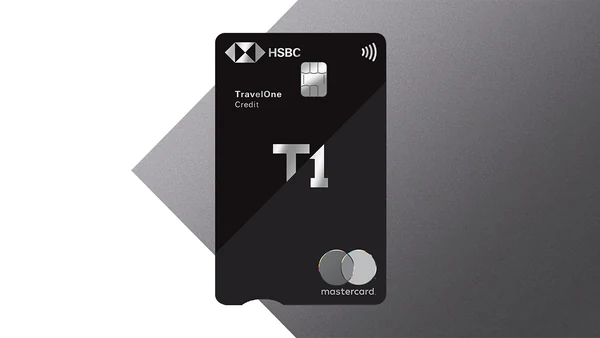
The HSBC TravelOne Credit Card charges ₹4,999 a year and gives the whole fee back to anyone who spends ₹8,00,000 on it. The Axis Horizon Credit Card charges ₹3,000 and gives it back to nobody, because its record carries no spend-linked waiver at all. Underneath those two prices sit two cards with the same base engine: 2 points per ₹100 on everything, each point worth ₹1. So HSBC TravelOne vs Axis Horizon is not an argument about earn rates on ordinary spending, because on ordinary spending the two are indistinguishable. It is an argument about what each bank assumed its cardholder would do with the card, and the two banks assumed very different things.
Five things separate them, and we have worked each one out in rupees rather than adjectives. The summary sits at the end of this post, after the working rather than in front of it.
HSBC TravelOne vs Axis Horizon: the annual fee waiver only one card has
Start with the fee, because it is the only figure on either card that is guaranteed to happen.
The HSBC TravelOne costs ₹4,999 at joining and ₹4,999 at every renewal, waived in full above ₹8,00,000 of annual spend. No waiver on the joining fee is published, so the first ₹4,999 is unavoidable. ₹8,00,000 a year works out to ₹66,667 a month routed through one card, every month, without a gap. For scale inside the same market, the Axis Bank Magnus Credit Card sets its waiver at ₹25,00,000, so HSBC's bar is not the highest in India. It is still roughly four times the fee expressed in monthly spend, and most cardholders will never reach it.
The Axis Horizon costs ₹3,000 at joining and ₹3,000 at renewal, with nothing in its record that switches the fee off. That reads worse on paper and behaves better in practice for most people. A 1,500 EDGE Mile renewal benefit lands from the second anniversary, and at ₹1 a Mile that is ₹1,500 back, so the running cost settles near ₹1,500 a year from year two onward. A fixed ₹1,500 is a smaller problem than a ₹4,999 fee attached to a threshold a cardholder keeps missing by ₹2,00,000.
Put the two running costs side by side below the waiver bar and the gap is ₹3,499 a year in HSBC's disfavour. Hold that number. Every advantage the TravelOne has later in this comparison has to earn ₹3,499 before it means anything.
Two more breakevens are worth writing down. Covering ₹4,999 of fee from base rewards alone, at 2 points per ₹100 valued at ₹1, needs ₹2,49,950 of annual spend. Covering the Horizon's ₹3,000 needs ₹1,50,000, and from year two, covering the ₹1,500 residual needs ₹75,000. Both cards ask ₹6,00,000 of annual income from salaried applicants. HSBC caps entry at age 65 against Axis at 70, and HSBC's own catalogue note records that self-employed applicants face ₹12,00,000 of income and a minimum age of 25.
Identical floors, different ceilings on the earn rate
Both cards pay 2 points per ₹100 on general spending, both value a point at ₹1, and neither publishes a monthly cap on that base rate. For two products sold as a premium travel credit card in India, that is an unusually flat starting position. A cardholder putting ₹50,000 a month through either card collects 12,000 points or Miles a year, worth ₹12,000. There is no separation to find here, which is unusual for two cards priced ₹1,999 apart.
The accelerated tiers pull in opposite directions. Axis pays 5 EDGE Miles per ₹100 on Travel EDGE portal bookings and direct airline spends. HSBC pays 4 reward points per ₹100 on flights and on travel aggregator bookings. Book ₹1,50,000 of flights directly with the airline and the Horizon returns 7,500 Miles against the TravelOne's 6,000 points, a ₹1,500 difference. Book the same ₹1,50,000 through an aggregator and the position inverts hard: HSBC still pays 4 per ₹100 for ₹6,000, while Axis drops that spend to its 2 per ₹100 base for ₹3,000. That is ₹3,000 to HSBC, which is very nearly the whole ₹3,499 cost gap, from one booking channel.
Exclusions matter more than either bank advertises. The Horizon's record lists fuel, wallet loads, government payments, EMI conversions and rental transactions as earning nothing at all. HSBC's base rate carries no published category exclusions. A cardholder routing ₹20,000 a month of rent through a card, ₹2,40,000 a year, is looking at ₹4,800 of points on one card and zero on the other. Against that, the Horizon carries a 1% fuel surcharge waiver on transactions between ₹400 and ₹5,000, capped at ₹400 a month, and the TravelOne carries no fuel surcharge waiver at all. Fuel is a category where Axis refunds the surcharge but pays no reward, and HSBC pays the reward but refunds no surcharge.
Welcome benefits break cleanly for Axis. A single transaction of ₹1,000 or more inside 30 days releases 5,000 EDGE Miles, worth ₹5,000 against a ₹3,000 joining fee. HSBC's package needs ₹25,000 of spend inside 30 days for ₹1,000 cashback, and adds a ₹3,000 Postcard voucher, a three-month EazyDiner Prime membership and a ₹250 Amazon eGift voucher for online applications completed with video KYC. The priced components total ₹4,250 against a ₹4,999 joining fee, so the first year lands ₹749 short before the unpriced membership is counted. Further out, HSBC credits 10,000 bonus points once annual spend passes ₹12,00,000, which is ₹4,00,000 beyond the waiver bar and will rarely change anyone's decision.
The foreign currency tier, worked out net of the 3.5% markup
Here is the calculation that makes this comparison worth writing down, and it is the one figure on the TravelOne that most descriptions of the card skip.
HSBC pays 4 reward points per ₹100 on spends billed in a foreign currency. At ₹1 a point, that is ₹4 returned on every ₹100 spent abroad, a 4.0% rate. HSBC also charges a 3.5% foreign currency markup plus applicable taxes on the same transaction, which is ₹3.50 per ₹100 before tax. Stop the arithmetic there and the tier looks positive by ₹0.50 per ₹100. The tax is what settles it.
Now add the tax. The levy applies to the ₹3.50 markup, not to the ₹100 of spend, so the question is how much of ₹3.50 it takes. It only has to take ₹0.50 to wipe the gain out entirely, and ₹0.50 divided by ₹3.50 is 14.3%. GST on a credit card fee or charge in India runs at 18%, which AU Small Finance Bank's schedule of charges states in exactly those terms for all fees, interest and charges. That rate sits above the 14.3% line, so the gain is gone. Multiply 3.5% by 1.18 and the billed markup is 4.13%, or ₹4.13 per ₹100, against ₹4.00 earned. Spending abroad on the TravelOne is net negative by ₹0.13 on every ₹100.
The point value makes it considerably worse, and ₹0.13 is the best case rather than the typical one. HSBC does not publish one rupee value per reward point; its redemption page states a range from ₹0.25 to ₹1.00 depending on the redemption chosen, and the ₹1 figure used above sits at the very top of that band, reachable only through the 1:1 airline and hotel transfers. Redeem the same 4 points as merchandise at the bottom of the band and ₹100 of foreign spend returns ₹1.00 against a ₹4.13 billed markup, a loss of ₹3.13 per ₹100. Every rung of that range is a loss. Only the size of it is in question, and the range runs from ₹0.13 to ₹3.13 per ₹100.
Against that, the Horizon is worse again, with nothing ambiguous about it. Foreign spends earn the 2 Miles per ₹100 base, ₹2 returned against the same 3.5% markup, which is ₹1.50 short before tax and ₹2.13 short once the 18% is applied. HSBC is still 2 percentage points better on foreign currency, and that gap survives the correction intact: the markup and the tax charged on it are identical on both cards, so both cancel out of the comparison and the whole difference is 4 points against 2. That is worth ₹2 on every ₹100 spent overseas. Converting it into the ₹3,499 annual cost gap takes ₹1,74,950 of foreign currency spend a year. Below roughly ₹1,75,000 spent abroad annually, HSBC's less bad forex tier does not pay for HSBC's higher fee.
For anyone weighing markup against benefits more generally, we have set out the trade in zero forex markup versus lounge access. One HSBC data point belongs here though: the HSBC Live+ Credit Card charges a 1.99% markup, well under the TravelOne's 3.5%, but earns no cashback on international spends at all, which leaves it at a flat 1.99% loss per ₹100 before tax. A lower markup with no earn is not automatically the better foreign currency card.
Lounge access comparison: 40 visits against 10
Nothing else in this comparison is as lopsided as the lounge counts.
The Axis Horizon record publishes 32 complimentary domestic visits a year on the Visa variant, structured as eight a quarter, plus eight international visits a year through Priority Pass at two a quarter. The HSBC TravelOne record publishes six domestic visits a year and four international visits a year through LoungeKey, with no spend gating attached. That is 40 complimentary visits against 10.
Divide the fee by the visits and the picture sharpens. A Horizon holder who uses all 40 pays ₹75 per visit in year one and, once the 1,500 Mile renewal benefit is netted off, ₹37.50 per visit from year two. A TravelOne holder who uses all 10 pays ₹499.90 per visit, and that is before the ₹8,00,000 waiver is reached.
Two caveats sit on those numbers, and both come from the records rather than from us. The Axis record carries a variant split: 32 domestic visits a year on the Visa variant at eight a quarter, but 24 a year on the Mastercard variant at six a quarter. The card's network field in the same record reads Visa. A reader shopping this card should confirm which variant is being issued, because the difference is eight lounge visits a year. The same record also notes that the Dreamfolks domestic lounge partnership ended in July 2025 and that domestic access now runs through an updated Axis lounge programme, a note dated to a 10 May 2026 verification. HSBC's constraint is different in kind: its six domestic visits are drawn from a fixed list of participating lounges that HSBC publishes, not from an open network, so the count and the coverage are separate questions.
One structural point cuts the other way. Axis publishes its allowance in quarterly blocks, so reaching 32 requires flying in all four quarters of the year. HSBC's six domestic visits are an annual figure. A traveller who takes one intense month of trips and then nothing for a year will not extract 32 visits from a quarterly instrument.
Airline transfer partners, and where the two rosters actually differ
Both cards are built on 1:1 transfers, and both have exceptions that matter.
HSBC lists 15 airline programmes and 5 hotel programmes, with most partners moving at one point to one mile or one loyalty point, and transfers running instantly from the app. Air India Maharaja Club, Singapore Airlines Krisflyer, Qatar Airways Privilege Club, British Airways Executive Club, Marriott Bonvoy, ALL Accor Live Limitless and IHG One Rewards all sit at that flat rate. Four partners are worse: Turkish Miles&Smiles, United MileagePlus and Hainan Fortune Wings take two points per mile, and Shangri-La Circle takes five. One is better, with airasia rewards paying three miles per point. Points stay valid for three years.
Axis moves EDGE Miles 1:1 to its established partners, with Singapore Airlines KrisFlyer and Etihad Guest confirmed at that rate and posting within seven working days. The roster changed materially on 2 April 2026. ALL Accor Live Limitless and Marriott Bonvoy were removed, closing both premium hotel paths. British Airways Executive Club, Finnair Plus and Vietnam Airlines LotusSmiles were added at 2:1. Surviving hotel partners are IHG One Rewards, Wyndham Rewards, Radisson Rewards, ITC Hotels and Orchid Rewards.
Read those two lists together and a specific reader appears. A KrisFlyer collector gets exactly the same thing from both cards: 2 miles per ₹100 of general spend, 1:1, no difference worth paying ₹1,999 more for. A British Airways Avios collector gets 2 Avios per ₹100 from HSBC and 1 Avios per ₹100 from Axis, because the same programme sits at 1:1 on one roster and 2:1 on the other. And a Marriott Bonvoy or Accor collector gets 1:1 access on HSBC and no access at all on Axis since April 2026. The TravelOne's transfer list is the single place where its higher fee buys something the Horizon cannot supply at any spend level. One gap in the records: HSBC publishes a three-year point validity and the Axis record carries no stated EDGE Mile expiry, so we have not compared them on that.
The five points of separation, side by side
Those five separations condense to one line each, with the arithmetic above standing behind every figure in the right-hand columns.
| Point of separation | HSBC TravelOne | Axis Horizon |
|---|---|---|
| Price and waiver | ₹4,999 joining, ₹4,999 annual, waived above ₹8,00,000 annual spend | ₹3,000 joining, ₹3,000 annual, no spend-linked waiver published |
| Earn rate | 2 points per ₹100 base, 4 per ₹100 on flights, travel aggregators and foreign currency | 2 EDGE Miles per ₹100 base, 5 per ₹100 on Travel EDGE and direct airline bookings |
| Foreign currency | 3.5% markup billing at 4.13% after 18% GST, 4 points per ₹100 earned, net minus ₹0.13 per ₹100 | 3.5% markup billing at 4.13% after 18% GST, 2 EDGE Miles per ₹100 earned, net minus ₹2.13 per ₹100 |
| Lounge visits a year | 6 domestic, 4 international via LoungeKey | 32 domestic on the Visa variant and 24 on the Mastercard variant, 8 international via Priority Pass |
| Transfers | 15 airline and 5 hotel programmes, most at 1:1, points valid 3 years | 1:1 to established partners, 2:1 on the three partners added in April 2026 |
The single spender this splits on
Take the Axis Horizon. At ₹3,000, falling to roughly ₹1,500 from year two after the renewal Miles, with the same 2 points per ₹100 base rate, a better 5 per ₹100 on direct airline bookings, a fuel surcharge waiver the other card lacks and 40 complimentary lounge visits a year against 10, it delivers more of what a travel card is bought for at 60% of the sticker price and a fraction of the effective one.
The caveat is a single number, and it is ₹8,00,000. A cardholder who genuinely routes ₹66,667 a month through one card sees the HSBC fee go to zero, and at zero the comparison inverts completely: an uncapped base rate with no category exclusions, 4 points per ₹100 on aggregator bookings that Axis pays nothing extra on, a foreign currency tier that loses ₹0.13 per ₹100 where the Horizon's loses ₹2.13, and 1:1 access to Marriott Bonvoy and ALL Accor Live Limitless, both of which left the Axis roster in April 2026. That spender should hold the TravelOne. Everyone below the bar is paying ₹3,499 a year for a shorter lounge list and a transfer roster they may never use.
Sources
- HSBC India, HSBC TravelOne Credit Card product page, https://www.hsbc.co.in/credit-cards/products/travelone/ . Source of the ₹4,999 joining and annual fee, the ₹8,00,000 waiver threshold, the 2 and 4 points per ₹100 earn rates, and the 6 domestic and 4 international lounge counts. Checked 14 September 2026.
- HSBC India, TravelOne rewards page, https://www.hsbc.co.in/credit-cards/products/travelone/rewards/ . Source of the 15 airline and 5 hotel transfer partners and their ratios, including the 2:1 and 5:1 exceptions and the airasia 1:3 rate. Checked 14 September 2026.
- HSBC India, HSBC TravelOne Credit Card terms and conditions, https://www.hsbc.co.in/content/dam/hsbc/in/documents/credit-cards/hsbc-travelone-credit-card-tnc.pdf . Source of the 3.5% foreign currency markup plus applicable taxes used in the net-of-markup calculation. Checked 14 September 2026.
- AU Small Finance Bank, Most Important Terms and Conditions with Schedule of Charges, https://www.au.bank.in/credit-cards/mitc%28with-schedule-of-charges%29.pdf . Source of the 18% GST rate applied to all credit card fees, interest and charges, used to turn the 3.5% markup into the 4.13% billed rate on both cards. Checked 14 September 2026.
- HSBC India, reward point redemption page, https://www.hsbc.co.in/credit-cards/how-to-redeem-credit-card-reward-points/ . Source of the published ₹0.25 to ₹1.00 per point redemption range and the three-year point validity. Checked 14 September 2026.
- HSBC India, participating lounge list, https://www.hsbc.co.in/content/dam/hsbc/in/documents/lounge-list-tnc.pdf . Source of the fixed participating-lounge condition on the 6 domestic visits. Checked 14 September 2026.
- HSBC India, HSBC Live+ Credit Card product page, https://www.hsbc.co.in/credit-cards/products/live-plus/ . Source of the 1.99% markup and the exclusion of international spends from cashback, used as within-issuer context. Checked 14 September 2026.
- Axis Bank, Axis Horizon Credit Card product page, https://www.axis.bank.in/cards/credit-card/axis-horizon-credit-card . Source of the ₹3,000 joining and annual fee, the absence of a published waiver, the 2 and 5 EDGE Miles per ₹100 rates, the 5,000 Mile welcome and 1,500 Mile renewal benefits, the lounge counts and variant split, and the fuel surcharge waiver terms. Checked 14 September 2026.
- Axis Bank, EDGE Miles transfer page, https://www.axis.bank.in/miles-transfer . Source of the 1:1 established partner ratios, the 2 April 2026 roster change, and the surviving hotel partner list. Checked 14 September 2026.
- Axis Bank, Axis Bank Magnus Credit Card product page, https://www.axis.bank.in/cards/credit-card/axis-bank-magnus-credit-card . Source of the ₹25,00,000 waiver threshold used only as scale context. Checked 14 September 2026.
- This site's card catalogue, verified against issuer Most Important Terms and Conditions documents. HSBC TravelOne verified 6 August 2026, HSBC Live+ verified 6 August 2026, Axis Horizon verified 10 May 2026, Axis Magnus verified 2 July 2026. Source of all card-level figures reproduced above. Checked 14 September 2026.
Disclosure: this post contains affiliate links. If you apply through them we may earn a commission, at no extra cost to you. Our editorial view is independent of that. #ad

Frequently asked
Which is cheaper to hold, the HSBC TravelOne or the Axis Horizon?
The Axis Horizon, at ₹3,000 a year against ₹4,999, and its 1,500 EDGE Mile renewal benefit cuts the running cost to about ₹1,500 from year two. The HSBC TravelOne only becomes the cheaper card at ₹8,00,000 of annual spend, where its fee is waived in full.
Is the HSBC TravelOne worth using for foreign currency spending?
No. Four reward points per ₹100 at ₹1 a point returns 4%, while the 3.5% markup bills at 4.13% once 18% GST is added, so the tier loses ₹0.13 on every ₹100. That is at HSBC's top point value; at ₹0.25 a point the loss is ₹3.13.
Which card gives more airport lounge visits, the HSBC TravelOne or the Axis Horizon?
The Axis Horizon, by a wide margin. Its record publishes 32 domestic visits a year on the Visa variant and eight international visits through Priority Pass, against six domestic and four international on the HSBC TravelOne. The Mastercard variant of the Horizon records 24 domestic visits instead of 32.
Does the Axis Horizon credit card have an annual fee waiver?
No spend-linked waiver appears in its record, so the ₹3,000 annual fee is a fixed cost every year. A 1,500 EDGE Mile renewal benefit credited from the second anniversary offsets roughly half of it at ₹1 a Mile, which is the only published relief on the fee.
Which card transfers to airlines at a better ratio, the HSBC TravelOne or the Axis Horizon?
The HSBC TravelOne. It lists 15 airline and five hotel programmes with most at 1:1, though Turkish, United and Hainan take two points per mile and Shangri-La five. Axis moves EDGE Miles 1:1 to KrisFlyer and Etihad Guest but 2:1 to the three partners added in April 2026.
Card devaluations, reward maths, and rate changes the day they land.
Follow on X
Reader comments
No comments yet. Share your experience with this card below — the first useful comment helps every reader after you.
Comments are moderated before they appear. Share your real experience with a card — what worked, what didn't, what the bank told you. We don't publish promotional content, referral links, or personal financial details. Keep it useful for other readers.