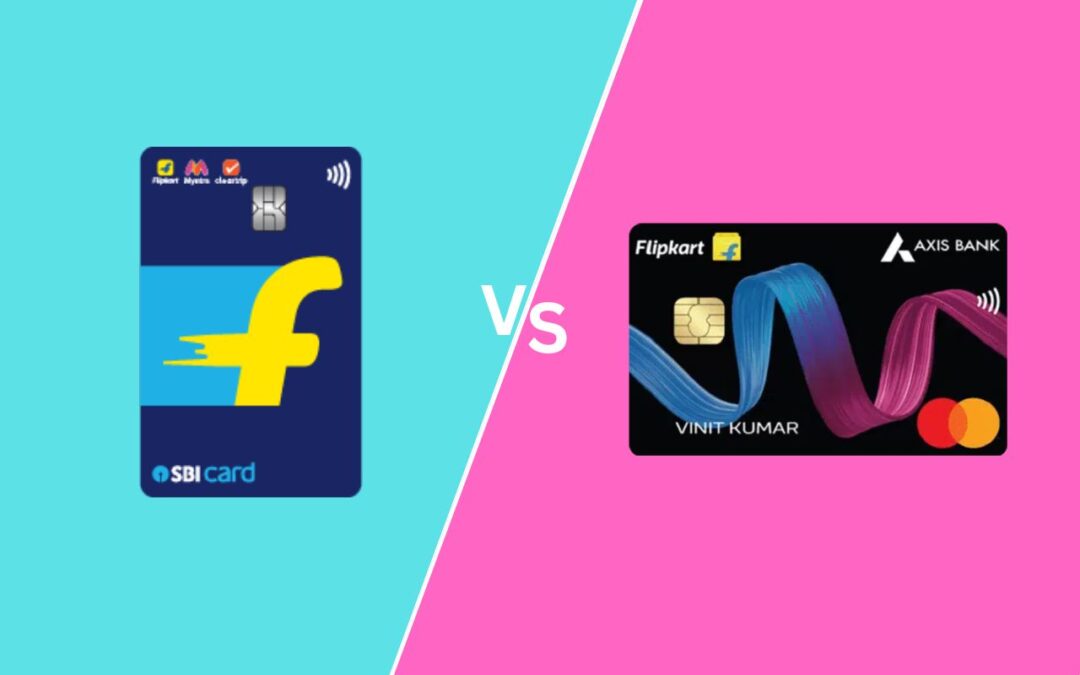
Which is better, the Axis Flipkart card or the SBI Flipkart card? That is the search, near enough word for word, and the search expects a winner. Axis Flipkart vs SBI Flipkart credit card ought to resolve cleanly, because two cards sitting over one retailer should be separable. It does not resolve cleanly. Both charge ₹500 to join and ₹500 a year. Both pay 7.5% on Myntra and 5% on Flipkart. Both stop at ₹4,000 of cashback per category per quarter. On the basket most people are buying the card for, these are arithmetically the same card wearing two different logos.
That is an unsatisfying answer, so the rest of this is the work of finding where it stops being true.
Axis Flipkart vs SBI Flipkart credit card: same store, same fee
The Axis Flipkart Credit Card and the SBI Flipkart Credit Card are both Visa co-brands on the same retailer, and the two catalogue records line up to an uncomfortable degree. Joining fee ₹500 on each. Annual fee ₹500 on each. The annual fee waiver triggers at ₹3,50,000 of annual spend on each, which is ₹29,167 a month. Forex markup is 3.5% on each. Minimum income is ₹3,00,000 on each, with self-employed applicants accepted on both. Lounge access on each: zero domestic visits, zero international.
Rate cards are near-twins too. Myntra pays 7.5%. Flipkart pays 5%. Cleartrip pays 5%. A named partner tier pays 4%, and every other eligible spend pays 1%. Anyone comparing headline rates alone finds nothing to choose between, which is why this Flipkart credit card cashback comparison has to move into the cap structure and the merchant lists before it earns its keep. A reader coming to this fresh may want how credit card cashback works in India first, because the whole separation here turns on how a cap is drawn rather than on what percentage sits above it.
One piece of housekeeping before the arithmetic. The third name people reach for in this conversation is the ICICI Amazon Pay Credit Card, which is not an active record in this site's catalogue, so it is not a live recommendation here and gets no column below.
The quarterly cashback cap, and exactly where it binds
Both cards cap the accelerated tiers at ₹4,000 per category per quarter, and both keep Flipkart, Myntra and Cleartrip in separate buckets rather than pooling them into one shared allowance. Separate buckets matter more than the cap size does. Three buckets of ₹4,000 is ₹12,000 a quarter, or ₹48,000 a year, before the 4% and 1% tiers are counted at all.
Where each bucket binds is a division. At 5% on Flipkart, ₹4,000 of cashback takes ₹80,000 of Flipkart spend in the quarter (₹4,000 divided by 0.05), which annualises to ₹3,20,000. At 7.5% on Myntra, ₹4,000 takes ₹53,333 in the quarter (₹4,000 divided by 0.075), or ₹2,13,333 across a year. As a Myntra cashback card, either one stops paying above ₹53,333 a quarter, and they stop at the same rupee.
Add the two together and the Flipkart-plus-Myntra ceiling is ₹5,33,333 of annual spend across the pair, returning ₹32,000 a year. Below that figure the caps are dormant on both cards. Above it they bind on both cards, for the same amount. On rate and on cap structure these are one card issued twice, and no level of annual Flipkart-plus-Myntra spend separates them on the arithmetic alone. What can still separate two identical sets of arithmetic is the clock each cap runs against, which is the third difference below and a far smaller lever than a rate gap would be. Worth saying plainly, because a great deal of the writing about this pair implies a rate gap that is not there.
Neither record settles one question: what a rupee earns after its category cap is exhausted for the quarter. Whether it falls back to the 1% base or earns nothing at all is not stated in either catalogue entry. That is the single most useful thing to ask the issuer before a sale weekend, and the answer changes how a ₹1,50,000 appliance purchase should be split across billing cycles.
Four places the two records separate
Once the co-brand basket is set aside as a tie, four differences are left. They are not equally important, and the order below is roughly the order in which they will matter to a real cardholder.
- The 4% tier's ceiling. The Axis Bank card's 4% tier is uncapped. The SBI Card version caps its 4% tier at ₹4,000 a quarter, the same as every other accelerated bucket, which is ₹16,000 a year and binds at ₹1,00,000 of partner spend per quarter (₹4,000 divided by 0.04), or ₹4,00,000 a year. Very few people spend ₹4,00,000 a year on food delivery and cab rides. For the ones who do, the Axis card keeps paying 4% and the SBI card does not.
- Who sits in the 4% tier. Axis Bank names cult.fit, PVR, Swiggy and Uber. SBI Card names Netmeds, Zomato, PVR and Uber. PVR and Uber are on both lists, so the tiebreak is food delivery against pharmacy: Swiggy and a gym subscription on one side, Zomato and Netmeds on the other. A household that orders Zomato four nights a week is choosing the SBI card on that fact alone, and no amount of Flipkart spending will overturn it. Axis Bank also records that its preferred-merchant list is subject to change without notice, which is worth reading as written.
- How the cap clock runs. The Axis Bank record defines its quarter explicitly as a statement quarter, meaning a rolling three statement cycles rather than a calendar quarter. SBI Card's record says "per quarter" and leaves the term undefined. Planning a large purchase against a cap is a different exercise depending on which clock is running, and a rolling statement quarter cannot be lined up against Big Billion Days on a calendar without knowing the statement date.
- What the base tier is made of. Both cards pay 1% on everything else, and both pay it as cashback. The SBI Card record additionally carries a rewards block with a
defaultRateof 0 and adefaultRewardValueof 0 sitting next to its cashback block. That zero is not a devaluation and should not be read as one. It records that no points programme runs alongside the cashback, so there is nothing to convert, no catalogue to redeem against, and no transfer ratio to track. The Axis Bank record carries no points programme at all. Neither card hands its holder a redemption decision, which is the correct design at this fee level.
The Axis card's case, and the two holes in it
Start with the uncapped 4% tier, which is the largest thing working in the Axis Bank card's favour: on a card where every other accelerated bucket stops at ₹4,000 a quarter, one tier with no ceiling is a genuine structural advantage for a high-spend metro household running Swiggy, Uber and PVR through a single card. Its cap language is also unusually precise for an Indian co-brand. Flipkart, Myntra and Cleartrip are stated as capped separately and not pooled, and the statement quarter is defined rather than assumed, which means a cardholder can actually model the ceiling instead of guessing at it. And its fuel surcharge waiver is recorded as a flat 1% waiver with no transaction band and no monthly ceiling attached, where the SBI record carries both.
Two things count against it, and the first is small money that shows up at exactly the wrong time. Axis Bank records no welcome benefit on this card, so the first year costs the full ₹500 joining fee plus the ₹500 annual fee with nothing offsetting either. Second, the rolling statement quarter that makes the cap precise also makes it harder to work with. A calendar quarter can be planned against a sale date; three rolling statement cycles have to be tracked off a billing statement, and a cardholder who splits a large purchase across what looks like two quarters may discover both halves landed in the same one. Full terms sit on the Axis Flipkart Credit Card page.
Where the SBI card gives ground
SBI Card has two real advantages here. A ₹250 Flipkart gift card arrives once the joining fee is paid, which is the only welcome benefit on either card and cuts first-year break-even by a measurable amount. And the upper age limit is 65 against 60 on the Axis card, which is not a detail for most applicants but is decisive for the ones it affects, since a 62-year-old self-employed applicant has exactly one of these two cards available.
Against that:
- The 4% partner tier is capped at ₹4,000 a quarter, or ₹16,000 a year. The Axis card's equivalent tier has no ceiling, so anyone pushing more than ₹4,00,000 a year through PVR, Uber and food delivery earns less here on every rupee past that line.
- The fuel surcharge waiver is narrower on both edges. It applies only to fuel transactions between ₹500 and ₹4,000, and it caps at ₹400 a month. The Axis record states a 1% waiver with neither a band nor a monthly cap.
- The record itself rests on thinner evidence. A 2 July 2026 audit and a 5 July 2026 residue check corrected the SBI Flipkart Credit Card's cashback categories outright and corrected its lounge access to zero, so the rates quoted here were re-sourced rather than carried forward unverified. What that audit did not do is read them off an SBI Card document: it settled them against a catalogue verification, where the Axis entry was reconciled on 13 July 2026 against Axis Bank's own cashback terms and conditions document. Both records are usable; one of them is better evidenced. The SBI Flipkart Credit Card page carries the same caveat.
For symmetry, one figure on the Axis side deserves the same treatment: its ₹500 joining and ₹500 annual fee are recorded at medium confidence, corroborated but not read off an issuer fee schedule. Confirm the fee on the application page before signing.
Side by side, only on what differs
Everything identical has already been covered: fee, waiver threshold, forex markup, minimum income, lounge access, the 7.5% and 5% and 1% rates, and the ₹4,000 quarterly cap on Flipkart, Myntra and Cleartrip. What follows is only the residue.
| What differs | Axis Flipkart Credit Card | SBI Flipkart Credit Card |
|---|---|---|
| 4% partner tier cap | Uncapped | ₹4,000 per quarter, ₹16,000 a year |
| Named 4% merchants | cult.fit, PVR, Swiggy, Uber | Netmeds, Zomato, PVR, Uber |
| Cap clock | Statement quarter, a rolling three statement cycles | Stated as "per quarter", not defined further |
| Welcome benefit | None recorded | ₹250 Flipkart gift card after the joining fee is paid |
| Fuel surcharge waiver | 1% waived, no band or monthly ceiling recorded | 1% on transactions of ₹500 to ₹4,000, capped at ₹400 a month |
| Upper age limit | 60 | 65 |
| Catalogue record verified | 13 July 2026, against issuer terms | 2 July 2026, rates corrected against a catalogue check |
Seven rows, and only one of them is worth more than a few hundred rupees a year to an ordinary household. That is the shape of this comparison.
Neither, if your Flipkart year is small
Both cards cost ₹500 a year plus 18% GST, which is ₹590 actually billed. In a renewal year, recovering ₹590 takes ₹11,800 of Flipkart spend at 5% (₹590 divided by 0.05), or ₹7,867 of Myntra spend at 7.5% (₹590 divided by 0.075). The first year is harder, because the ₹500 joining fee lands too: ₹1,180 with GST, which takes ₹23,600 of Flipkart spend on the Axis card. The SBI card's ₹250 gift card brings its first-year cost to ₹930, so it breaks even at ₹18,600 of Flipkart spend, ₹5,000 lower.
So the floor is roughly this. A Flipkart-plus-Myntra year under about ₹24,000, all of it at the 5% rate, loses money on the Axis Flipkart Credit Card in year one. Under about ₹19,000, the SBI Flipkart Credit Card loses money too. Both figures fall to ₹11,800 from year two, identical, because the gift card never comes again. A household spending ₹1,500 a month across Flipkart and Myntra sits at ₹18,000 a year, earning ₹900 at the 5% rate: ahead of a ₹590 renewal year, behind a ₹1,180 first year.
Below that line, the correct card is not one of these two. It is a lifetime-free card with no annual fee to recover, which turns every rupee of cashback into a gain rather than a partial refund of something already paid. A free card earning a flat rate on all spend also has no category to stay inside and no quarterly cap to track, which is worth something on its own to a light shopper. The options worth reading are in the best lifetime-free credit cards in India for 2026.
And above that line, the answer is whichever of these two carries the food-delivery app already on the phone. That is a slightly absurd basis for a credit card decision. It is also, after all the arithmetic, the one difference that will actually show up on a statement.
Sources
- Axis Bank, "Flipkart Axis Bank Credit Card" product page, https://www.axis.bank.in/cards/credit-card/flipkart-axisbank-credit-card. Source of the Axis card's fee structure, cashback tiers and preferred-merchant list. Checked 14 September 2026.
- Axis Bank, "Most Important Terms and Conditions, Credit Cards", https://www.axis.bank.in/docs/default-source/default-document-library/mitc-credit-cards.pdf. Source of the ₹4,000 per-category cap, the statement-quarter definition and the fee waiver threshold. Checked 14 September 2026.
- SBI Card, "Flipkart SBI Card" product page, https://www.sbicard.com/en/personal/credit-cards/flipkart-sbi-card.html. Source of the SBI card's cashback tiers, partner-merchant list and welcome benefit. Checked 14 September 2026.
- SBI Card, "Key Fact Statement", https://www.sbicard.com/sbi-card-en/assets/docs/pdf/key-fact-statement.pdf. Source of the SBI card's joining and annual fee, the ₹3,50,000 waiver threshold and the fuel surcharge waiver terms. Checked 14 September 2026.
- Card-level figures in this comparison come from this site's catalogue, verified against issuer Most Important Terms and Conditions documents. The Axis Flipkart Credit Card record was verified on 13 July 2026; the SBI Flipkart Credit Card record was verified on 2 July 2026, with its cashback categories and its lounge access corrected in that audit and in a 5 July 2026 residue check. Checked 14 September 2026.
Disclosure: this post contains affiliate links. If you apply through them we may earn a commission, at no extra cost to you. Our editorial view is independent of that. #ad

Frequently asked
Which is better, the Axis Flipkart or the SBI Flipkart credit card?
Neither is better on rate. Both pay 7.5% on Myntra, 5% on Flipkart and Cleartrip, and both cap each of those at ₹4,000 per quarter. The Axis Bank card leaves its 4% partner tier uncapped; the SBI Card version caps that tier at ₹4,000 a quarter as well.
What is the quarterly cashback cap on the Flipkart credit cards?
₹4,000 per category per quarter on both cards. At 5% on Flipkart that cap binds at ₹80,000 of Flipkart spend in the quarter, and at 7.5% on Myntra it binds at ₹53,333. Flipkart, Myntra and Cleartrip are capped separately rather than pooled together.
Is the ₹500 annual fee waiver easier on the Axis or SBI Flipkart card?
It is identical. Both waive the ₹500 annual fee at ₹3,50,000 of annual spend, which works out to ₹29,167 a month. The SBI Card version adds a ₹250 Flipkart gift card once the joining fee is paid, so its first year costs ₹250 less than the Axis one.
Do either of these Flipkart cards give lounge access?
No. Both catalogue records show zero domestic and zero international lounge visits. The Axis Bank card carried complimentary domestic lounge access until the 20 June 2025 revision of its cashback terms discontinued it, alongside moving Flipkart and Cleartrip from uncapped cashback to the ₹4,000 quarterly cap.
Which Flipkart card is the better Myntra cashback card?
Both pay 7.5% on Myntra with the same ₹4,000 quarterly ceiling, so neither is better at Myntra itself. The tiebreak sits one tier down: the Axis Bank card's 4% list carries Swiggy and cult.fit, while the SBI Card list carries Zomato and Netmeds.
Card devaluations, reward maths, and rate changes the day they land.
Follow on X
Reader comments
No comments yet. Share your experience with this card below — the first useful comment helps every reader after you.
Comments are moderated before they appear. Share your real experience with a card — what worked, what didn't, what the bank told you. We don't publish promotional content, referral links, or personal financial details. Keep it useful for other readers.