Pixel Play does not beat Pixel Go on any single rate. It cannot. Every earning tier the Pixel Go has, the Pixel Play also has, then it adds tiers the Pixel Go has no answer to.
So this is not a contest of rates. It is ₹250 of extra annual fee and a ₹1,00,000 waiver bar twice as high as its sibling's, set against an accelerated ceiling worth ₹18,000 a year. Pixel Play wins for most people who will genuinely use the card, and the reader it loses to is narrower than the fee gap suggests.
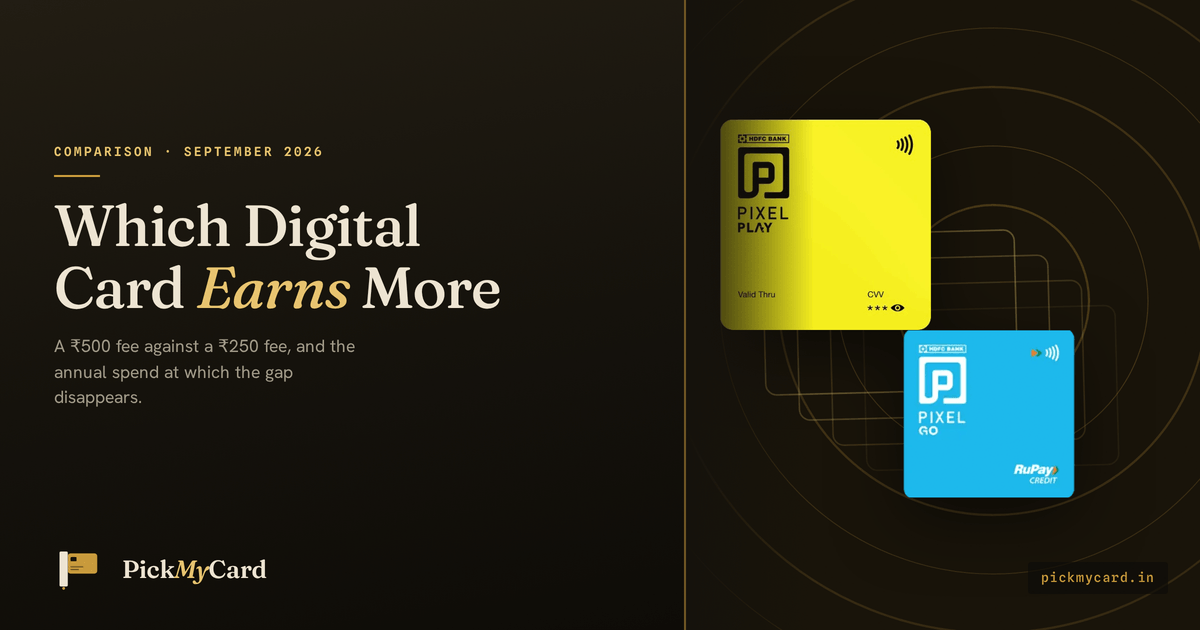
One rate sheet contains the other
Set the two cards side by side and the Pixel Go's earning structure disappears inside the Pixel Play's. Pixel Go pays 5% on HDFC SmartBuy, capped at 500 CashPoints a month, and 1% on everything else. That is the entire accelerated menu: one tier.
Pixel Play carries that same SmartBuy tier at the same ceiling and stacks three more on top:
- 5% on a first category you pick from a menu that includes Amazon, Flipkart, Swiggy and Uber, capped at 500 CashPoints a month
- 5% on a second pick from the same menu, with its own 500 CashPoint ceiling
- 3% on ONE of PayZapp, Amazon or Flipkart, again capped at 500 CashPoints
Those three ceilings add to 1,500 CashPoints in a calendar month, and CashPoints convert to statement credit at 1:1. Over a year that is ₹18,000 of earning the Pixel Go structurally cannot reach, because it has nowhere to put the spend. Per-tier ceilings and the category lock-in are covered in our Pixel Play review.
A ceiling is not a promise, though, and the spend it takes to reach one is not the same on every tier. Each 5% category fills at ₹10,000 a month, but the 3% pick needs ₹16,667 to earn its own 500 CashPoints. All three together therefore want about ₹36,700 a month inside the right categories, not the ₹30,000 a quick reading suggests. A reader who cannot feed them is comparing two cards on a difference they will never collect.
Two waiver bars, not one
Pixel Go charges ₹250 plus GST on both counts, an effective ₹295 at 18%, waiving the joining fee on ₹10,000 of spend inside the first 90 days and the annual fee on ₹50,000 in the previous membership year, about ₹4,200 a month.
Pixel Play charges ₹500 plus GST on both counts, an effective ₹590, and waives joining and annual fees on ₹1,00,000 of annual spend, about ₹8,333 a month.
Feature: both cards let an active holder carry them for nothing.
Caveat: they define "active" differently, and Pixel Play defines it at twice the level. A reader running ₹6,000 a month sits comfortably above the Pixel Go bar and comfortably below the Pixel Play one.
Utility: in that middle band the fee gap is not ₹295 but the full ₹590, because one card is charging nothing at all. That doubling is why the crossover is worth computing rather than eyeballing.
The crossover, in rupees
Pixel Play's extra tiers pay 4 percentage points more than Pixel Go on the same rupee, since a chosen category earns 5% where Pixel Go earns its base 1%. Divide each band's fee gap by those 4 points for the annual chosen-category spend at which Pixel Play stops costing you money.
| Annual spend on the card | Fee you pay on Pixel Go | Fee you pay on Pixel Play | Chosen-category spend that cancels the gap | Card ahead |
|---|---|---|---|---|
| Under ₹50,000 | ₹295 | ₹590 | ₹7,375 a year, about ₹615 a month | Pixel Go, until you clear ₹7,375 |
| ₹50,000 to ₹99,999 | ₹0, waived | ₹590 | ₹14,750 a year, about ₹1,229 a month | Pixel Go, until you clear ₹14,750 |
| ₹1,00,000 and above | ₹0, waived | ₹0, waived | Nil, both cards are free | Pixel Play |
PickMyCard calculation from the fee and cap figures in our card data, assuming 18% GST and CashPoints redeemed at 1:1.
Read the middle row twice, because it is the only one that ever favours Pixel Go on a meaningful sum. A reader spending ₹70,000 across the year needs about ₹14,750 of it inside their two chosen categories before the ₹590 comes back, roughly a fifth of the total. That is a real bar, not a heroic one, for anyone who orders food or shops online with any regularity.
Above ₹1,00,000 of annual spend the question dissolves: both fees vanish and Pixel Play is earning on tiers its sibling does not have.
What neither Pixel card does
Strip out the cashback and these are the same product, worth saying before anyone reads the fee difference as a quality difference. Neither carries lounge access, both apply a 3.5% forex markup and the same 1% fuel surcharge waiver, both run through PayZapp, and eligibility is identical at ₹3,00,000 of annual income.
Their exclusions overlap almost completely: rent, EMI conversions, fuel, wallet loads and gift card purchases sit outside the accelerated rates on both, and most miss the base 1% as well. Each card's base tier carries the same ₹15,000 monthly cap, and that figure caps cashback earned in the month rather than spend, so it only bites past roughly ₹15 lakh of monthly spend. CashPoints on both need manual redemption and can attract a ₹99 handling charge below certain thresholds.
The shared 5% SmartBuy tier is the one accelerator both cards hold, and SmartBuy has its own history of tightened ceilings, which our SmartBuy voucher cap analysis sets out.
The one question that settles this
Everything above reduces to a single figure you already know: how much of your year lands inside two categories you would choose.
For most readers who will actually use the card, that figure clears ₹15,000 without effort, and the Pixel Play is the card to take. It cancels the worst-case ₹590 fee gap on roughly ₹15,000 of chosen-category spend, its rate sheet contains the Pixel Go's entirely, and it is rated 4.2 out of 5 against the Pixel Go's 3.9. Our roundup of the best HDFC credit cards puts both in the wider range.
The caveat is the ₹1,00,000 waiver bar, twice the Pixel Go's: if your spending is spread thin, or sits in rent and fuel, the second-year fee lands with no recourse when the pace slips, so check the running total by month nine rather than month twelve. If it is not going to land, the cheaper card is the honest answer.
Disclosure: this post contains affiliate links. If you apply through them we may earn a commission, at no extra cost to you. Our editorial view is independent of that. #ad

Frequently asked
Is the HDFC Pixel Play or the Pixel Go better?
Pixel Play earns more, because its rate sheet contains every tier the Pixel Go has and adds 5% on two categories you choose plus 3% on one e-commerce pick. The question is whether that extra earning covers the extra fee. Pixel Play costs ₹500 plus GST against Pixel Go's ₹250 plus GST, so the gap is ₹295 a year at 18% GST. About ₹7,375 of annual spend inside a chosen 5% category cancels it, on our calculation.
What is the difference between the Pixel Play and Pixel Go annual fee waiver?
Pixel Go waives its ₹250 annual fee on ₹50,000 of spend in the previous year, roughly ₹4,200 a month, and waives the joining fee on ₹10,000 of spend inside the first 90 days. Pixel Play waives its ₹500 joining and annual fees on ₹1,00,000 of annual spend, roughly ₹8,333 a month. The bar on Pixel Play is twice as high.
How much more can the HDFC Pixel Play earn than the Pixel Go in a month?
Pixel Play's two chosen 5% categories and its 3% e-commerce pick each carry a ceiling of 500 CashPoints a month, so those tiers top out at 1,500 CashPoints. Pixel Go has no equivalent tiers. Both cards carry the same 5% HDFC SmartBuy tier at 500 CashPoints a month and the same 1% base rate, so the accelerated gap between them is 1,500 CashPoints a month, or ₹18,000 a year at the 1:1 CashPoint conversion.
Which HDFC Pixel card is better for a first credit card?
Pixel Go, on fee mechanics alone. Its ₹250 plus GST fee waives at ₹50,000 of annual spend and its joining fee waives at ₹10,000 in the first 90 days, so a light user can hold it at no cost. Eligibility is identical on both cards at ₹3,00,000 of annual income, ages 21 to 65, with self-employed applicants accepted, so the choice is about spending, not approval.
Do the Pixel Play and Pixel Go have lounge access?
Neither card carries complimentary domestic or international lounge access. Both also apply a 3.5% forex markup and both offer the same 1% fuel surcharge waiver on transactions between ₹400 and ₹5,000. On benefits outside cashback, the two cards are the same card.
Card devaluations, reward maths, and rate changes the day they land.
Follow on X
Reader comments
No comments yet. Share your experience with this card below — the first useful comment helps every reader after you.
Comments are moderated before they appear. Share your real experience with a card — what worked, what didn't, what the bank told you. We don't publish promotional content, referral links, or personal financial details. Keep it useful for other readers.