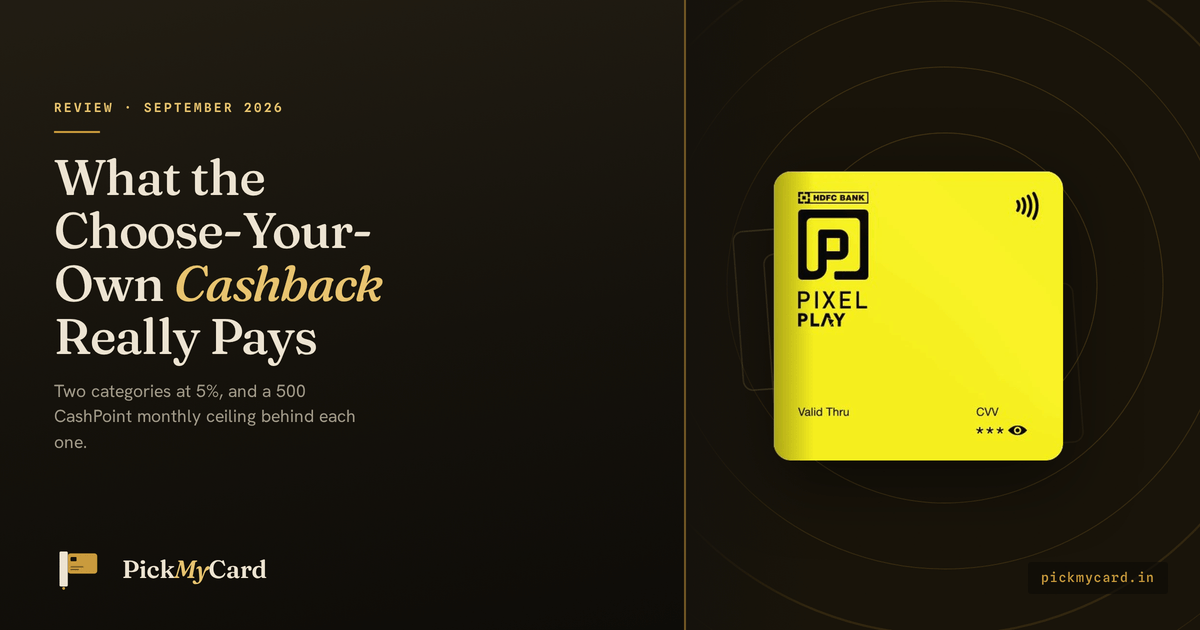
Pixel Play hands you the reward menu. You pick two categories from a list that includes Amazon, Flipkart, Swiggy and Uber, and those two pay 5%. Almost every write-up leads with that sentence.
The figure that decides what the choice is worth sits a line lower. Each accelerated category is capped at 500 CashPoints a month, a ceiling that arrives at 5% on ₹10,000 of spend in that category. Which categories you pick matters; how quickly you fill them matters more.
What Pixel Play pays, tier by tier
Every accelerated tier carries its own ceiling, and CashPoints convert to statement credit at 1:1, so a point reads as a rupee.
| Tier | Rate | What it covers | Monthly ceiling |
|---|---|---|---|
| First chosen category | 5% | one pick from the menu (Amazon, Flipkart, Swiggy, Uber and others) | 500 CashPoints |
| Second chosen category | 5% | a second pick from the same menu | 500 CashPoints |
| E-commerce pick | 3% | ONE of PayZapp, Amazon or Flipkart | 500 CashPoints |
| HDFC SmartBuy | 5% | a separate tier, distinct from the two chosen categories | 500 CashPoints, on our reading |
| Everything else | 1% | all remaining eligible spend | ₹15,000 of cashback |
Two rows need reading twice. The 3% tier applies to one of PayZapp, Amazon or Flipkart, chosen by you, not PayZapp and SmartBuy bundled, since SmartBuy sits on its own 5% tier. The rate sheet states the 500-point ceiling per accelerated category rather than naming SmartBuy, so reading SmartBuy as capped at 500 is PickMyCard's reading of that rule.
The last row is a different unit: its ₹15,000 caps cashback earned in a month, not spend, so the base tier runs to roughly ₹15 lakh of monthly spend before it stops paying. Switching a chosen category later needs a cooldown and a fresh PayZapp request, so the first pick matters. Our guide to how cashback works in India covers per-category ceilings in general.
The 500-point ceiling is the whole card
Feature: you set the 5% categories, so the top rate follows your spending instead of a bank's merchant list.
Caveat: the ceiling is per category, not per card, and it is small. Both chosen categories filled hand you 1,000 CashPoints. Add the 3% pick and the SmartBuy tier at their own 500-point ceilings and the four accelerated tiers reach 2,000 CashPoints between them. Nothing from the base 1% rate is inside that figure, and there is no fifth accelerated tier to add.
Utility: at ₹20,000 in one chosen category the tier still returns 500 CashPoints, so the headline rate has halved. Two categories at ₹10,000 each beat one at ₹20,000, on identical total spend.
The spends that never reach the 5%
Rent, EMI conversions, fuel, wallet loads and gift cards are ineligible for the 5% rate and mostly miss the base 1% too. UPI spends earn the base 1% rather than an accelerated rate, a real disappointment on a card sold as digital-first, and education fees and insurance premiums sit at 1%.
There is no lounge access, domestic or international, and forex markup is 3.5%, so this is not a card to carry abroad. The one perk outside cashback is a 1% fuel surcharge waiver between ₹400 and ₹5,000, with no cashback on the fuel itself.
Fees, the waiver bar, and the ₹99 you can avoid
Joining and annual fees are ₹500 plus GST each, an effective ₹590 at 18%, and the annual fee is waived on ₹1,00,000 of spend in the previous membership year, about ₹8,333 a month.
That bar is low relative to the card's own ceilings. Anyone filling both 5% categories spends roughly ₹20,000 a month and clears ₹1,00,000 in five. Anyone below ₹8,333 a month is paying ₹590 for tiers they are not filling. Our fee waiver guide shows how to test that against your statements.
CashPoints need manual redemption, and converting them can attract a ₹99 handling charge below certain thresholds, so batch them. Revolved balances run at around 3.6% a month, which no rate here comes close to covering.
Who it fits, and who should skip it
It fits a digital-first spender with two heavy online categories rather than one, each landing near ₹10,000 a month, and confident of clearing ₹1,00,000 across the year. Eligibility is undemanding: ₹3,00,000 of annual income, ages 21 to 65, self-employed applicants accepted.
Skip it if your spending concentrates in one category, because half the earning power sits in the second pick, or if rent, fuel, wallet loads and UPI carry most of your month. If ₹1,00,000 looks like a stretch, the lifetime-free Axis Neo RuPay removes the fee question and the ₹250 Pixel Go waives at ₹50,000 a year.
Should you apply?
4.2 out of 5, and the rating rests on the fee floor rather than the ceiling: ₹590 is a small entry price for a card whose top rate you define. What it does not endorse is the way the 5% is usually pitched, because read as an uncapped rate Pixel Play underdelivers from the first heavy month. Against the HDFC Millennia, at ₹1,000 with a fixed ten-merchant list, it costs less and lets you choose.
Check three months of statements, pick the two categories closest to ₹10,000 each, and confirm the ₹1,00,000 pace by month nine, because the second-year fee lands with no recourse if it slips.
Disclosure: this post contains affiliate links. If you apply through them we may earn a commission, at no extra cost to you. Our editorial view is independent of that. #ad



Frequently asked
How much cashback can the HDFC Pixel Play actually pay in a month?
Each accelerated category is capped at 500 CashPoints a month. Four accelerated tiers carry that ceiling: the two categories you pick at 5%, the 3% e-commerce pick, and HDFC SmartBuy at 5%. On our reading of the per-category rule they top out together at 2,000 CashPoints in a calendar month. That figure covers the accelerated tiers only and excludes anything earned at the base 1% rate. CashPoints convert to statement credit at 1:1, and spending more in a category once its 500 points are earned does not raise what that category pays.
How much do you need to spend to max out a 5% category on Pixel Play?
₹10,000 in that category in the month, on our calculation: 5% of ₹10,000 is 500 CashPoints, which is the per-category ceiling. Two chosen categories therefore reach their combined ceiling at about ₹20,000 of monthly spend between them.
Is the HDFC Pixel Play annual fee worth paying?
The joining and annual fees are ₹500 plus GST each, and the annual fee is waived on ₹1,00,000 of spend in the year, which is roughly ₹8,333 a month. A cardholder who fills both 5% categories recovers the fee inside the first month. A cardholder who cannot reach the waiver bar is paying a real fee for a card whose accelerated tiers they are not filling either.
Does the HDFC Pixel Play earn cashback on UPI, rent and fuel?
UPI spends earn at the base 1% rate rather than an accelerated one. Rent, EMI conversions, fuel, wallet loads and gift card purchases are ineligible for the 5% rate, and most of them miss the 1% base rate as well. Education fees and insurance premiums earn 1%.
Does the HDFC Pixel Play come with lounge access?
No. The card carries no complimentary domestic or international lounge visits. Its only non-cashback benefit is a 1% fuel surcharge waiver on transactions between ₹400 and ₹5,000.
Card devaluations, reward maths, and rate changes the day they land.
Follow on X
Reader comments
No comments yet. Share your experience with this card below — the first useful comment helps every reader after you.
Comments are moderated before they appear. Share your real experience with a card — what worked, what didn't, what the bank told you. We don't publish promotional content, referral links, or personal financial details. Keep it useful for other readers.