The consent date on the Standard Chartered to Federal Bank migration passed on 31 July 2026. That closes the question people were asking before it, and opens a different one: what has already been decided on your behalf, and what is left to do while the accounts move.
Two things were always in play, and only one of them was ever yours to decide. The account is moving to Federal Bank. Whether you hold a Federal Bank card on the other side is what the consent date settled.
Standard Chartered's migration FAQ puts the first half beyond argument, in its first answer: "As part of a business decision, your Standard Chartered credit card account(s) will be transferred to Federal Bank." Nothing in the consent flow changes that sentence.
That distinction matters because the word on the button is Decline, and Decline reads like an exit. It is not one. The FAQ is unambiguous: "The Decline option only indicates that you do not wish to receive a new Federal Bank Credit Card. It does not affect the transfer of your existing credit card account to Federal Bank."
Foreign banks have been shedding Indian retail books for years, and cardholders keep discovering that a portfolio sale is not a product they get to opt out of. This one had a consent date of 31 July 2026, and roughly 4.5 lakh cards behind it. Completion is expected within calendar year 2026, so for most people the account move is still ahead of them even though the decision is behind them.

The portfolio Federal Bank bought
Federal Bank announced the acquisition on 30 April 2026, describing a portfolio of approximately 4.5 lakh credit cards bought from Standard Chartered Bank, India.
The valuation was put at roughly 1.5 to 1.6 times implied equity, with the final consideration linked to actual balances at the time of transfer. Completion is expected within calendar year 2026. Federal Bank expects its non-co-branded credit card receivables to rise by approximately 90% as a result.
At the level of your individual account, the FAQ lists what moves: "Your Credit Card relationship, including your credit limit, reward points and any outstanding balance, will be transferred to Federal Bank."
There is no paperwork attached to it. "No additional documentation or KYC formalities are required for this transfer," the FAQ says. You are not being re-underwritten, and you are not applying for anything.
Accept, Decline, or do nothing
There were two ways to consent. Click [I Agree] in the communication, or send ACCEPT to 9702363363.
A third way existed whether anyone intended it or not, and it is the one still running. "Continued usage of your credit card(s) after 31 July 2026 will also be treated as consent." A single swipe on or after 1 August is consent, and a new Federal Bank credit card follows. If you have spent on the card this month, that is the path you are on.
One action that looks like consent is not consent. The FAQ is explicit that payment of your credit card outstanding is not treated as consent. Clearing your bill is a payment, nothing more. Do not treat a paid statement as a decision you have already made.
Decline is the option people get backwards. Decline stops the new card, and it stops nothing else. The FAQ spells out the cost: "by selecting Decline, your Standard Chartered credit card and its associated benefits, including your credit limit, rewards, and cardholder benefits, will cease upon migration." Your account and your balance still go across.
Declining and then continuing to swipe does not reverse the choice either. That combination is addressed directly: keep using the card after the date communicated over email, and "Federal bank will not issue a replacement card to you subject to your rejection."
Silence has the same shape. If you give no consent and stop using the card, the FAQ's scenario table says: "No new Federal Bank credit card will be issued," and "Your outstanding balance will still be transferred to Federal Bank and must be repaid to Federal Bank."
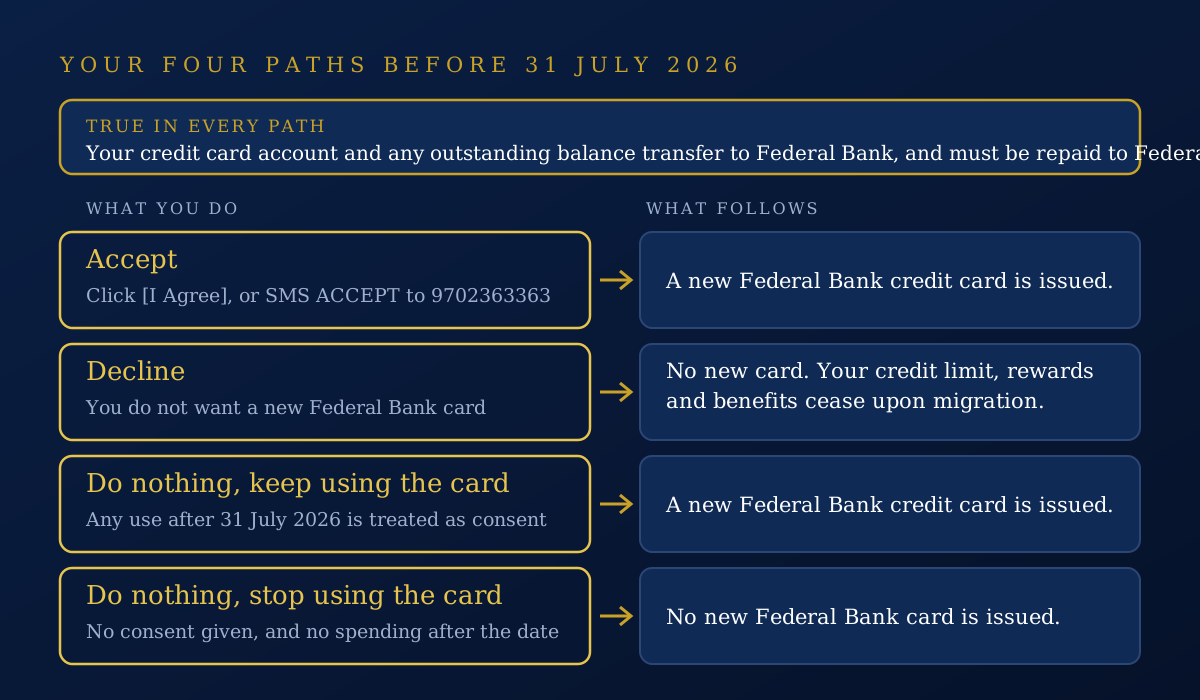
What the migration FAQ does not answer
The consent document is short, and several things a cardholder needs are simply not in it. Treat the gaps as gaps, not as reassurance.
- Standing instructions, auto-debit and autopay mandates are not addressed anywhere in the consent document, even though the FAQ is otherwise specific about what travels with the account.
- An active EMI's tenure, interest rate and repayment schedule go unmentioned. Only the money is covered, because any outstanding balance transfers to Federal Bank and must be repaid there.
- A redemption cut-off date for reward points is not published. What is stated is narrower: points transfer if you accept, and on Decline rewards cease upon migration.
- Add-on and supplementary cards never appear. The document speaks only of your credit card account being transferred to Federal Bank.
- Card number, PIN, annual fee, and which existing benefits survive on the new Federal Bank card are all left unstated, alongside the assurance that no additional documentation or KYC formalities are required.
- The date the accounts actually move is nowhere in the document. 31 July 2026 is the consent deadline, not a stated migration date.
The EMI boundary is worth stating precisely. An EMI balance is an outstanding balance, so the FAQ's transfer language covers the money. It says nothing about the terms attached to that money.
What to do now
The decision window has closed. The record-keeping window has not, and it matters more now than it did in July, because the accounts have not moved yet and the migration date is still unpublished.
- Download your latest Standard Chartered credit card statement and save it outside the bank's app.
- Note your current credit limit and your available limit as of today.
- Note the outstanding principal, remaining tenure and interest rate on any running EMI or loan-on-card.
- List every standing instruction, auto-debit and autopay mandate riding on the card, and plan to verify each one after the migration, because the FAQ makes no commitment about them.
- If you declined, or went quiet and stopped spending, treat reward points as the item with a live clock. Rewards cease upon migration, no redemption deadline is published anywhere in the FAQ, and the migration date is not published either. Points with an unpublished expiry and an unpublished cut-off are the one thing here that can be lost by waiting. Benefit withdrawals of this kind are what our credit card devaluation tracker records.
- Check whether you have spent on the card since 1 August. That single fact decides whether a new card is coming, and it is easier to establish from a statement than from memory.
None of that is a prediction about what either bank will do. It is the paperwork you will want if something needs correcting later.
Where you stand now
You were never choosing between Standard Chartered and Federal Bank. That choice was made on 30 April 2026, and your account is going across regardless.
What the consent date settled is whether you hold a Federal Bank credit card on the other side. Accepted, or used the card past 31 July 2026, and one is coming. Declined, or went quiet and stopped spending, and it is not, while the balance still follows you to Federal Bank. Federal Bank's own retail range, including the co-branded Federal Bank Scapia, is what that relationship looks like if you kept it.
One thing is worth being blunt about, because the deadline language has stopped applying and people read these posts late. Continued usage is still treated as consent. It is not a rule that expired on 31 July; it is the mechanism that has been running since 1 August. If you meant to decline and have since paid for something with the card, check your statement rather than assume the decline stood.
The rest is record-keeping, and the migration date has not been published. Keep the statement, the limits and the EMI terms somewhere you control until your account is demonstrably on the other side.
Sources

Frequently asked
What happens to my Standard Chartered credit card in the Federal Bank migration?
Standard Chartered India's credit card accounts are being transferred to Federal Bank as a business decision. Your credit limit, reward points and any outstanding balance move with the account. No additional documentation or KYC formalities are required. The transfer of the account itself does not depend on your consent.
If I decline, does my Standard Chartered account still transfer to Federal Bank?
Yes. Decline only means you do not want a new Federal Bank card, and it does not stop the account transfer. On Decline, your Standard Chartered card and its associated benefits, including credit limit, rewards and cardholder benefits, cease upon migration. The account and any balance still move.
I did not respond before the 31 July 2026 deadline. What happens now?
It depends on whether you have used the card since. Standard Chartered treats continued use after 31 July 2026 as consent, so a swipe in August already means a new Federal Bank card is issued. If you have neither consented nor spent since that date, no new card follows. Your account and balance transfer either way.
Does paying my Standard Chartered outstanding count as consent?
No. Standard Chartered's migration FAQ states that payment of your credit card outstanding will not be treated as consent. Consent is given only by clicking I Agree, by sending ACCEPT to 9702363363, or by continuing to use the card after 31 July 2026.
How many Standard Chartered cardholders does the Federal Bank migration affect?
Federal Bank's press release of 30 April 2026 puts the acquired portfolio at approximately 4.5 lakh credit cards. The bank expects completion within calendar year 2026, and projects that its non-co-branded credit card receivables will rise by roughly 90 percent.
Card devaluations, reward maths, and rate changes the day they land.
Follow on X
Reader comments
No comments yet. Share your experience with this card below — the first useful comment helps every reader after you.
Comments are moderated before they appear. Share your real experience with a card — what worked, what didn't, what the bank told you. We don't publish promotional content, referral links, or personal financial details. Keep it useful for other readers.