The rule you have probably quoted at a shopkeeper does not say what you think it says. Ask around and you will be told the RBI banned card surcharges years ago. It did something narrower, and the gap between the two is exactly where the ₹40 on your ₹2,000 bill lives. The protection for a credit card surcharge is real, but it does not come from where almost everyone assumes.
What the credit card surcharge rule actually covers
The instruction people are thinking of is RBI circular RBI/2017-18/105, issued on 6 December 2017 and effective from 1 January 2018. It rationalised the merchant discount rate, the cut a merchant pays its bank on a card transaction. One line in it does the work everyone remembers:
Banks are also advised to ensure that merchants on-boarded by them do not pass on MDR charges to customers while accepting payments through debit cards.
Read the last four words again. The circular is a debit card instruction. Its subject is debit card MDR, and it carries no credit card provision at all.
That is not an oversight to be outraged about. Debit card acceptance was being pushed as public infrastructure and priced accordingly. Credit cards were left to commercial terms between banks, networks and merchants. So when a shopkeeper adds 2% for a credit card, quoting the 2017 circular at him is quoting the wrong document, and he may well know it.
Where your protection actually comes from
It comes from a contract you are not a party to.
Every merchant that accepts cards signs an agreement with an acquiring bank, the bank whose terminal sits on the counter. That agreement, and the card network rules behind it, is where surcharging is restricted. The merchant discount rate is the merchant's cost of accepting the card, in the same way rent and electricity are costs of opening the shutter.
The practical consequence matters more than the legal theory. A shop adding a card fee is breaching its agreement with its own bank, and that bank can warn it, reprice it or withdraw the terminal. You are not filing a case. You are reporting a contract breach to the party who can enforce it, which is a far shorter route than it sounds.
There is a second charge that is not a breach at all, and confusing the two wastes everyone's time. A convenience fee is disclosed by a biller or booking platform before you confirm payment, for the payment channel itself. Railway bookings and several government and utility portals levy one. It appears on screen, you accept it, and it is not a counter surcharge. If you saw it before paying, you agreed to it.
The one surcharge that is legal, and mostly refundable
Fuel is the genuine exception. A 1% fuel surcharge at petrol pumps is a real industry levy, not a shopkeeper improvising, and it is charged legitimately.
What makes it a non-event for most people is that the card refunds it. Of the 86 active cards tracked here, 74 carry a fuel surcharge waiver. The waiver is never unconditional, though, and the conditions are where the money leaks:
| Card | Waiver band | The catch |
|---|---|---|
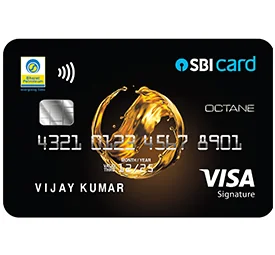
| BPCL SBI Card Octane | 1% on BPCL fills up to ₹4,000 | Capped at ₹100 per statement cycle, BPCL pumps only |
| HDFC Millennia | 1% on fills of ₹400 to ₹5,000 | Nothing outside the band is refunded |
| SBI SimplyCLICK | 1% on fills of ₹500 to ₹3,000 | Narrow upper bound for a full tank |
| ICICI Coral | 1% on fills up to ₹4,000 | No lower-band protection stated |
| Kiwi RuPay | None | Fuel is excluded from rewards entirely |
Three patterns are worth internalising. A band, not a threshold: fill below the floor or above the ceiling and you pay. A monthly or statement cap, so a heavy driver stops recovering partway through the month. And a network or brand restriction on co-branded fuel cards, which is the point of them.
The twelve active cards with no waiver are not defective. Some, like Kiwi and the Axis Cashback card, exclude fuel from rewards by design and price the rest of the card accordingly. If you rarely drive, that is a fair trade.
What to do when a shop asks anyway
Pay by another method if the amount is small and you want your evening back. If it is not small, three things make a complaint stick.
Note the acquiring bank, whose logo is printed on the card machine, not the bank that issued your card. Keep the charge slip and the bill, since the surcharge usually appears as a separate line or as a rounded-up total. Then raise it with that acquiring bank, which holds the merchant agreement.
If the bank does not resolve it within thirty days, the RBI's integrated ombudsman route is the escalation. Very few of these reach that stage, because a terminal is worth more to a shop than ₹40.
One caution. If the charge was disclosed before you paid, on a screen or a printed board, it is a convenience fee you accepted, and the complaint will go nowhere. The dispute is about charges added after you chose to pay by card.
How to pick
For most people this question decides nothing about which card to hold, and pretending otherwise would sell you something. Counter surcharging is a contract problem, not a product feature, and no card protects you from it better than any other.
Fuel is the exception, and it is worth one considered choice. If you fill up regularly, read the cap before the rate. Every card in the table waives the same 1%; they differ on the band and the ceiling, and the ceiling is what decides whether a monthly ₹6,000 fuel habit is fully covered or covered for three weeks. A co-branded fuel card such as BPCL SBI Card Octane pays the most at one chain and least everywhere else, while a general card like HDFC Millennia covers a wider band at any pump.
If you barely drive, ignore fuel waivers entirely and pick on the reward rate you will actually use. The same logic decides whether a RuPay credit card on UPI belongs in your wallet: match the card to the payment you actually make most often, not to the one that annoyed you last.
Sources
- Reserve Bank of India, Rationalisation of Merchant Discount Rate (MDR) for Debit Card Transactions, circular RBI/2017-18/105, DPSS.CO.PD No. 1633/02.14.003/2017-18, dated 6 December 2017, effective 1 January 2018. Quoted above; scope is debit card transactions.
- Fuel surcharge waiver bands, caps and exclusions are from this site's own card records, verified 10 August 2026. Counts of 86 active cards and 74 with a waiver are derived from the same records on that date.
Frequently asked
Is it illegal for a shop to charge extra for a credit card in India?
Not illegal in the sense of a specific RBI ban. The RBI instruction that stops merchants passing on card costs covers debit cards only. For credit cards the restriction sits in the shop's own agreement with its acquiring bank, so a surcharge is a contract breach the bank can act on.
What is the difference between a surcharge and a convenience fee?
A surcharge is an extra percentage added at the counter for choosing a card. A convenience fee is a disclosed charge levied by a biller or booking platform for the payment channel itself, shown before you confirm. The first is disputable with the acquiring bank. The second you agreed to.
Can a petrol pump charge 1% extra on a credit card?
Yes. The fuel surcharge is a genuine industry levy and is charged legitimately at petrol pumps. Most credit cards then refund it, usually 1% within a spend band and capped monthly, so it appears on your statement and reverses. Check the cap rather than assuming full recovery.
Who do I complain to if a shop adds a card fee?
Report it to the bank whose logo is on the card machine, since that acquiring bank holds the merchant agreement and can act on it. Note the date, amount and outlet. If the bank does not resolve it within thirty days, escalate through the RBI's integrated ombudsman route.
Card devaluations, reward maths, and rate changes the day they land.
Follow on X
Reader comments
No comments yet. Share your experience with this card below — the first useful comment helps every reader after you.
Comments are moderated before they appear. Share your real experience with a card — what worked, what didn't, what the bank told you. We don't publish promotional content, referral links, or personal financial details. Keep it useful for other readers.