
Your bank cannot let a transaction cross your credit limit and then bill you for the privilege, not anymore, and not unless you told it to first. That is the entire rule in one sentence, and most cardholders who have paid an overlimit fee at some point have never heard it stated this plainly.
It sits alongside a run of RBI consumer-protection moves through 2025 and 2026 that share one instinct: stop the card issuer from deciding something on the customer's behalf and calling it standard practice. The CIBIL misreporting timeline RBI enforces on issuers is the same instinct applied to credit reporting. This one applies it to your credit limit itself.
What an overlimit charge actually is
An overlimit charge is a fee for a transaction your issuer approved even though it pushed your outstanding balance past the sanctioned limit on your card. The feature sounds like a convenience: a payment goes through instead of getting declined at the worst possible moment.
The catch was never the fee amount. It was that most cardholders never asked for the buffer in the first place. The facility sat on by default at many issuers, so the first anyone learned about it was a line item on the statement, weeks after the transaction, for a service nobody had opted into.
The utility of that arrangement was close to zero. A safety net you did not know existed does not feel like a safety net when it charges you. It feels like a fee for a mistake the bank made on your behalf.
The rule that changed on 28 November 2025
The Reserve Bank of India issued the Commercial Banks – Credit Cards and Debit Cards: Issuance and Conduct Directions, 2025 (RBI/DOR/2025-26/155, DOR.AUT.REC.No.74/24-01-041/2025-26), dated 28 November 2025 and effective immediately. Paragraph 12(5), under Underwriting Standards, states it directly:
Card-issuers shall ensure that the credit limit as sanctioned and advised to the cardholder is not breached at any point in time without seeking explicit consent from the cardholder.
The Explanation attached to that paragraph does the practical work. Usage beyond the sanctioned limit requires prior explicit consent, framed by RBI as a fraud-minimisation mechanism, not a courtesy. The cardholder must be given an on/off control on the issuer's app, net banking or an equivalent digital channel. And unless that consent has been given, no overlimit can be provided and no overlimit charge can be levied, full stop.
A second clause closes a quieter trap. Interest and other charges already sitting on the card are no longer counted when the issuer calculates whether you have crossed your limit. Only new spending counts toward that test now, which matters for anyone whose balance crept over the line purely from accumulating interest rather than a new purchase.
| Before 28 November 2025 | Now | |
|---|---|---|
| Overlimit facility | Often on by default | Off by default, opt-in only |
| Charge without consent | Could be levied | Cannot be levied |
| Turning it off | Not always available mid-cycle | Single click, any time |
| Interest counted toward limit usage | Sometimes yes | Explicitly excluded |
How the toggle actually works
The mechanism RBI mandated is simple by design, and it is worth seeing as a sequence rather than a rule to memorise.
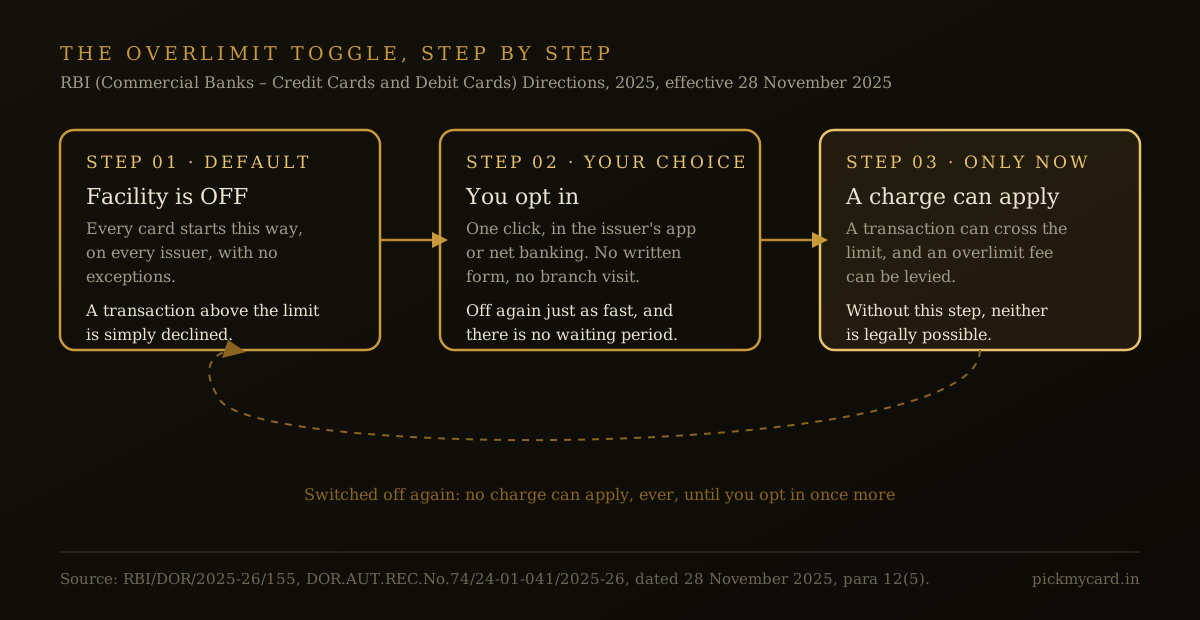
Every card ships with the facility switched off. That is the default RBI mandated, and no issuer gets to set a different one. A transaction that would push you over the limit is simply declined at the terminal, the same as any other insufficient-limit decline.
Turning it on is a customer decision, made in the moment it is actually wanted, not a box ticked once at onboarding and forgotten. Most issuers bury the control under transaction controls or card settings rather than a dedicated "overlimit" menu, so it is worth searching the app once to know where yours lives.
Only with the toggle on can a transaction cross the sanctioned limit, and only then can a fee apply. Switch it back off and the card returns to declining anything over the line, with no cooling-off period either way.
Who should actually turn it on
Feature: the toggle gives you a genuine one-time buffer, useful the day a hospital bill or a flight rebooking lands slightly above what your limit allows.
Caveat: turning it on does not waive the fee, it only permits the bank to charge one. Industry practice before this rule ran roughly 2.5% to 3% of the amount over the limit, or a flat minimum in the ₹500 range, whichever was higher, on top of GST and the ordinary interest already accruing on the excess. Nothing in the 2025 Directions caps that fee; they only govern consent.
Utility: the toggle earns its place for irregular-income cardholders and for anyone holding an entry-level card with a tight starting limit, such as a first card from IDFC FIRST WOW! or a RuPay card like Kiwi, where a routine purchase is more likely to brush the ceiling. It earns nothing for someone who just wants to avoid a declined checkout. That is what a higher sanctioned limit, requested directly, is for, and confusing the two means paying a fee for a problem a limit increase solves for free.
If you were charged before the rule changed
The Directions are not retroactive. A fee levied in 2024 or earlier in 2025 does not become refundable simply because the rule now exists, and no issuer is obligated to reopen old statements on its own.
There is still a route if the facility was never disclosed anywhere in your card's MITC and you were charged anyway. Raise it in writing with the issuer, citing the specific statement date and amount, and give it thirty days. If that goes nowhere, the RBI's integrated ombudsman is the next step, the same escalation path that applies to a mishandled credit report correction.
What to do this month
Open your card's app and find the overlimit or transaction-control setting once, even if you have never crossed your limit. Note whether it is on or off; a surprising number of cardholders discover it was switched on by an issuer default that predates this rule and was never revisited.
Turn it off if you would rather a transaction decline than a charged buffer. Leave it on only for a specific, live reason. And if your issuer raises your sanctioned limit at any point, the same explicit-consent principle now governs that change too, so check what you actually agreed to.
Sources
- Reserve Bank of India, Commercial Banks – Credit Cards and Debit Cards: Issuance and Conduct Directions, 2025, RBI/DOR/2025-26/155, DOR.AUT.REC.No.74/24-01-041/2025-26, dated 28 November 2025, paragraph 12(5) and Explanation. Full text of the Directions.
- Reserve Bank of India, Master Directions, official index, for the consolidated regulatory framework these Directions sit within.


Frequently asked
Can my bank still charge me an overlimit fee without asking?
No. Since 28 November 2025, RBI's Commercial Banks Credit and Debit Card Directions require explicit consent before a transaction can cross your sanctioned limit and before any overlimit charge can apply. If you have not opted in, the transaction is declined, not billed.
Where do I turn the overlimit facility on or off?
In your issuer's app or net banking, under transaction controls or card settings. The exact label varies (some call it an overlimit facility, others a temporary limit buffer), but RBI requires it to be a single click, available on the same platforms you already use.
Does interest on my existing balance count toward my credit limit for this purpose?
No. The same 2025 Directions specifically exclude interest and other charges from the calculation used to decide whether you have crossed your limit and whether an overlimit charge applies. Only new spending counts.
I was charged an overlimit fee before November 2025. Can I get it back?
The rule is not retroactive, so there is no automatic refund. You can still dispute a specific charge with your issuer if the overlimit facility was never disclosed to you in the MITC, and escalate to the RBI's integrated ombudsman if the issuer does not resolve it within thirty days.
Card devaluations, reward maths, and rate changes the day they land.
Follow on X
Reader comments
No comments yet. Share your experience with this card below — the first useful comment helps every reader after you.
Comments are moderated before they appear. Share your real experience with a card — what worked, what didn't, what the bank told you. We don't publish promotional content, referral links, or personal financial details. Keep it useful for other readers.