A due date that has not arrived cannot be overdue. That is the whole of the complaint now circulating among SBI Card holders, and it is a serious one.
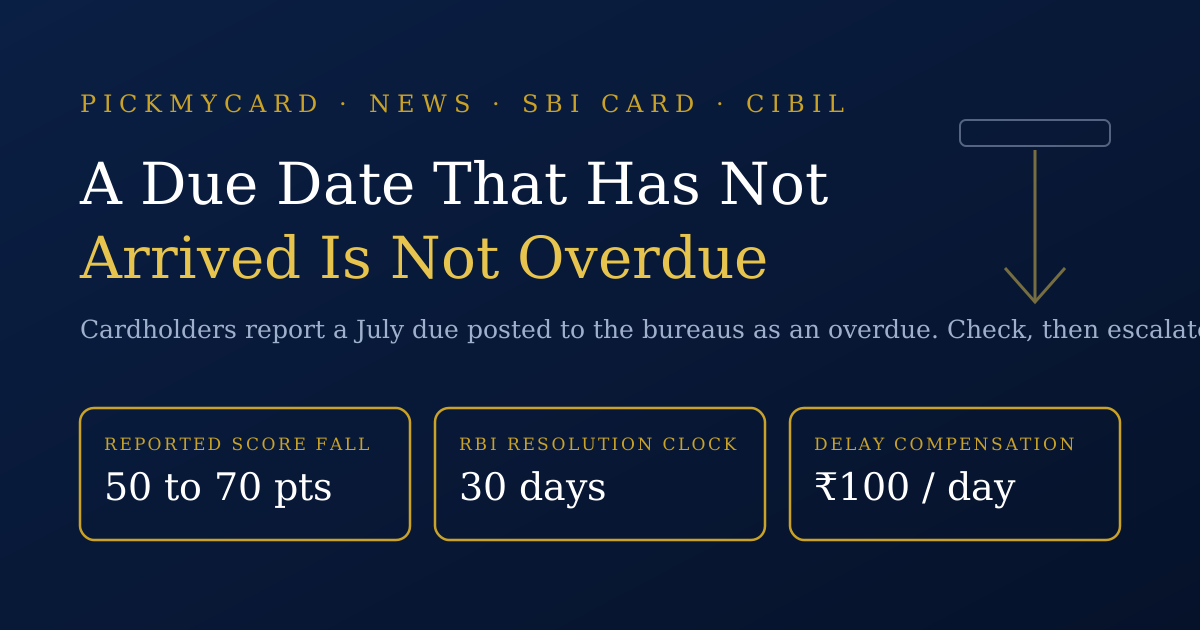
Cardholders posting on the TechnoFino community since 9 July 2026 say that SBI Card reported the current billing cycle's due amount to the credit bureaus as an amount overdue, on accounts where the payment due date had not yet arrived. Several describe statements generated on or around 9 July, with due dates falling on 20 July or later. Several report CIBIL score falls in the range of 50 to 70 points, including one account that moved from 779 to 709.
Users who contacted SBI Card support say the executives confirmed there was no overdue on the account, and asked them to put the complaint in writing.
Two caveats, stated plainly. SBI Card has issued no public statement on this as at 13 July 2026. And PickMyCard has not independently verified how many accounts are affected: the evidence available today is user-reported, from one community, and the pattern it describes may be narrower or wider than it looks. What follows assumes nothing about the cause. It assumes only that if your report is wrong, you want it fixed, and the clock is already running.
Why a phantom overdue costs so much
Payment history is the heaviest single input into a credit score. A single 30-day-past-due marker can move a strong file by 50 to 100 points, which is consistent with what affected users are describing.
The damage is not abstract. A 720 file and a 780 file are priced differently on a home loan. Cards get declined at 700 that sail through at 760. If you have a loan application, a balance transfer, or a card upgrade in the next quarter, this is not a wait-and-see item.
There is a second-order problem most people miss. Your issuer does not report to CIBIL alone. It reports to all four bureaus: TransUnion CIBIL, Experian, Equifax and CRIF High Mark. A bad data submission propagates to every one of them. Fix CIBIL, and a lender who happens to pull Experian still sees an overdue.
Step one: verify it on your own report, today
Do not act on a forum thread. Act on your own file.
Pull your CIBIL report. Open the Account Information section, find the SBI Card line, and read exactly two fields:
- Amount Overdue. On a card you have paid on time, this reads ₹0. Anything above zero, when your due date has not passed, is the error.
- DPD, the Days Past Due grid. This is the month-by-month payment history strip. A healthy month reads
000, orXXXwhere no data was reported. A number in the current month's cell, against a bill that is not yet due, is the marker doing the damage.
Screenshot both. Then save the report itself: only reports pulled within the past 60 days are eligible for dispute, so a fresh pull is also your entry ticket.
Repeat the check at Experian, Equifax and CRIF High Mark. All four offer a free consumer report.
Do not pay the "overdue" to make it go away. Paying an amount that was never overdue does not delete a wrongly reported marker. Pay your bill normally, on or before your real due date. Dispute the reported entry separately.
Step two: run both tracks at once
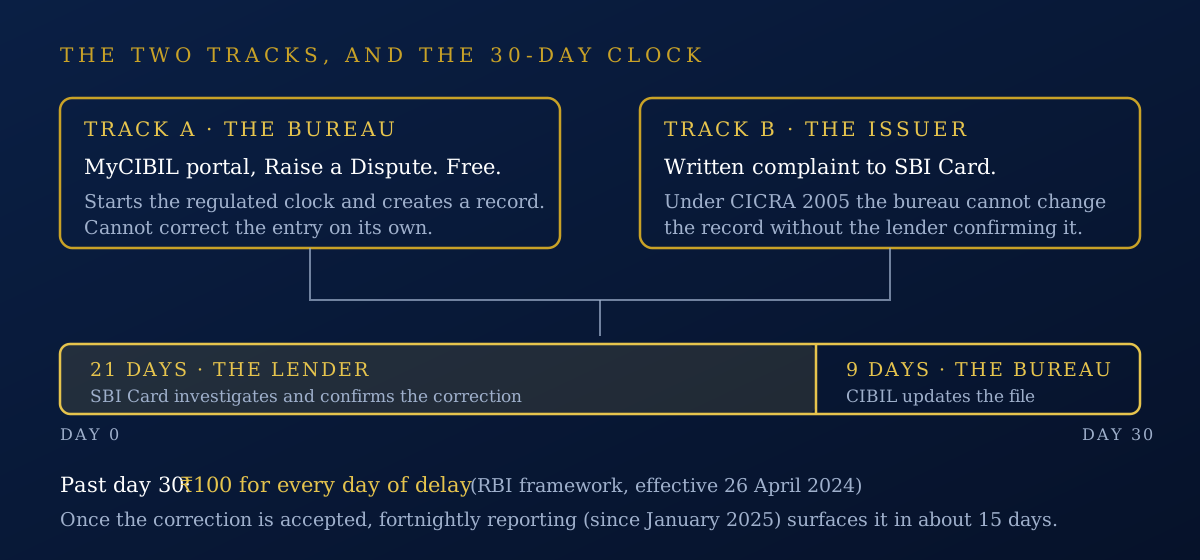
Here is the mechanic that decides whether this takes three weeks or three months. Under the Credit Information Companies (Regulation) Act 2005, a bureau cannot correct, delete or add anything without confirmation from the reporting lender. CIBIL is not the decision-maker. SBI Card is.
So a bureau dispute alone does not fix your file. What it does is start a regulated clock, and create a record. You need both tracks running in parallel from day one.
Track A, the bureau dispute. Log in to the MyCIBIL portal, open your latest report, select Raise a Dispute, choose Account Information, pick the query that matches (the overdue amount, or the payment history), and submit. It is free. CIBIL does not charge to correct a discrepancy, and any agent who asks you for a fee to "repair" your score is selling you something that does not exist.
Track B, the issuer complaint. Write to SBI Card. Email, not a phone call, because you need a paper trail and a reference number. Attach: the statement showing the actual payment due date, proof of your payment status, the CIBIL report page showing the overdue, and the interaction ID from any chat or call where support confirmed no overdue was outstanding.
Ask for one specific thing, in one sentence: a corrected data submission to all four bureaus, reversing the overdue and the DPD marker for the July 2026 cycle. Vague complaints get vague replies.
The escalation ladder, and the clock
Each rung needs the reference number from the rung below it. Skipping a level gets your complaint bounced back down. Every address below is taken from SBI Card's own published Grievance Redressal Policy.
| Level | Where it goes | What you send | Realistic wait |
|---|---|---|---|
| 1 | Customer care, customercare@sbicard.com | Statement, CIBIL report page, written complaint. Get a complaint reference number. | 7 working days, per SBI Card's policy |
| 2 | Nodal Officer, Nodalofficer@sbicard.com (helpline 1860-180-7777) | Level 1 reference number plus the same evidence | 7 to 10 days |
| 3 | Principal Nodal Officer, PrincipalNodalOfficer@sbicard.com | Level 2 reference and the unsatisfactory reply | 7 to 10 days |
| 4 | Customer Service Head, CustomerServiceHead@sbicard.com | Full chain of reference numbers | 7 to 10 days |
| 5 | RBI Integrated Ombudsman, cms.rbi.org.in | Only after 30 days with no resolution, or an unsatisfactory final reply | Regulated |
A quiet provision worth knowing about sits between levels 4 and 5. SBI Card refers every complaint it rejects, wholly or partly, to its Internal Ombudsman within 20 days, and the reply you get must state whether the Internal Ombudsman upheld or overruled that rejection. If your rejection letter does not say so, the referral has not happened, and that is worth pointing out in writing.
Now the part worth knowing before you start. RBI requires a credit report dispute to be resolved within 30 calendar days of receipt, split as 21 days for the credit institution and 9 days for the bureau. Under the compensation framework effective 26 April 2024, if it is not resolved in that window, you are entitled to ₹100 for every day of delay, credited to the bank account details you supply with the complaint. The liability sits with the lender, the bureau, or both, depending on where the delay occurred.
Provide your bank account details when you raise the dispute. The compensation cannot be credited if you have not.
One more piece of timing in your favour. Since January 2025, lenders report to the bureaus fortnightly rather than monthly. Once SBI Card accepts the correction and resubmits, the fix should surface on your file within about fifteen days, not thirty.
What to watch
Check your report now, even if you have never missed a payment, and even if your due date is still days away. This particular failure mode does not care about your payment behaviour. It is a data-submission problem, and the only signal that you are in it is the entry sitting on your own file.
If the marker is there, open both tracks today rather than on the weekend. The 30-day clock, and the compensation that attaches to it, runs from the date you raise the dispute, not from the date the error appeared.
We will update this post if SBI Card issues a statement, confirms a bulk reversal, or the pattern turns out to be narrower than the community reports suggest.
Sources
- SBI Card: current due posted as overdue today to CIBIL for my two cards (TechnoFino community thread, July 2026)
- Consumer Dispute Resolution: how to raise a dispute, 60-day report eligibility, CICRA 2005 confirmation requirement, 30-day resolution (TransUnion CIBIL, official)
- Framework for Compensation for delayed dispute resolution (TransUnion CIBIL, official)
- Credit Bureau FAQs (SBI Card, official)
- Customer Grievance Redressal Policy (SBI Card, official)
- SBI Card grievance redressal escalation matrix, including Principal Nodal Officer and Customer Service Head contacts (Paisabazaar)
- Reserve Bank of India Complaint Management System, Integrated Ombudsman Scheme
Frequently asked
What is the SBI Card CIBIL reporting issue reported in July 2026?
Cardholders on the TechnoFino community forum report that SBI Card sent their July billing cycle's current due to the credit bureaus as an amount overdue, even though the payment due date had not yet passed. Affected users describe statements generated around 9 July 2026 with due dates on or after 20 July, and CIBIL score falls of roughly 50 to 70 points. SBI Card has not issued a public statement on the matter as at 13 July 2026, and PickMyCard has not independently verified how many accounts are affected.
How do I check whether my SBI card has been wrongly marked overdue on CIBIL?
Pull your CIBIL report and open the Account Information section. Find the SBI Card line and read two fields: Amount Overdue and the DPD (Days Past Due) column in the payment history grid. If Amount Overdue is greater than zero, or the current month's DPD shows a number rather than 000 or XXX, while your statement's payment due date has not yet passed, the reporting is wrong. Save a copy of the report as evidence before you raise anything.
Should I pay the amount to make the overdue disappear?
Paying does not delete a wrong entry. If the amount was never overdue, the error is in what the issuer reported to the bureau, not in your payment. Pay your bill as normal on or before your actual due date, and dispute the reported overdue separately. A payment made early does not retroactively correct a wrongly reported DPD.
How do I raise a dispute with CIBIL, and does it cost anything?
Dispute resolution is a free service. Log in to the MyCIBIL portal, open your latest report, select Raise a Dispute, choose Account Information and the relevant query, and submit. Only reports pulled in the past 60 days are eligible for dispute, so pull a fresh one first. Under the Credit Information Companies (Regulation) Act 2005, CIBIL cannot correct the entry without confirmation from the reporting lender, so a bureau dispute alone is not enough.
How long does a credit report correction take, and is there compensation for delay?
RBI requires a dispute to be resolved within 30 calendar days of receipt, split as 21 days for the credit institution and 9 days for the bureau. Under the RBI framework effective 26 April 2024, a complainant is entitled to compensation of ₹100 for each day of delay beyond 30 days, credited to the bank account details provided with the complaint.
Where do I escalate if SBI Card does not fix it?
SBI Card's published Grievance Redressal Policy sets out a four-level ladder: customer care at customercare@sbicard.com, then the Nodal Officer at Nodalofficer@sbicard.com (helpline 1860-180-7777), then the Principal Nodal Officer at PrincipalNodalOfficer@sbicard.com, then the Customer Service Head at CustomerServiceHead@sbicard.com. Quote the previous interaction or complaint reference number at every step. Complaints that SBI Card rejects wholly or partly are referred to its Internal Ombudsman within 20 days. If the grievance is still unresolved 30 days after you first raised it, file a complaint on the RBI Integrated Ombudsman Scheme portal at cms.rbi.org.in.
Do I need to fix the error at bureaus other than CIBIL?
Yes, in most cases. Lenders report to all four bureaus operating in India: TransUnion CIBIL, Experian, Equifax and CRIF High Mark. An error in the issuer's data submission usually propagates to all of them. Correcting your CIBIL file leaves the other three wrong, and a lender pulling Experian rather than CIBIL will still see the overdue. Check all four and raise a dispute wherever the error appears.
Card devaluations, reward maths, and rate changes the day they land.
Follow on X
Reader comments
No comments yet. Share your experience with this card below — the first useful comment helps every reader after you.
Comments are moderated before they appear. Share your real experience with a card — what worked, what didn't, what the bank told you. We don't publish promotional content, referral links, or personal financial details. Keep it useful for other readers.