
Visa, Mastercard and RuPay differ in four ways that reach your wallet: where the card is accepted, whether it can be linked to UPI, the premium-tier perks the network supplies, and what merchants pay to accept it. Fees, reward rates and forex markup are not on that list. The issuing bank sets those.
India had about 12.29 crore credit cards outstanding in July 2026, and cardholders spent ₹23.62 lakh crore on them in FY2025-26, according to RBI's payment system indicators. Every one of those cards runs on a network. Most buyers never ask which one, and that is a mistake in exactly one direction: asking costs nothing.
Visa vs Mastercard vs RuPay credit card: who decides what on your card?
The issuer decides the money terms. The network decides the plumbing. The issuer is the bank or non-bank lender that sanctions your limit, bills you and answers your complaint. The network carries each payment between the merchant's bank, called the acquirer, and your issuer, and writes the rules both sides follow.
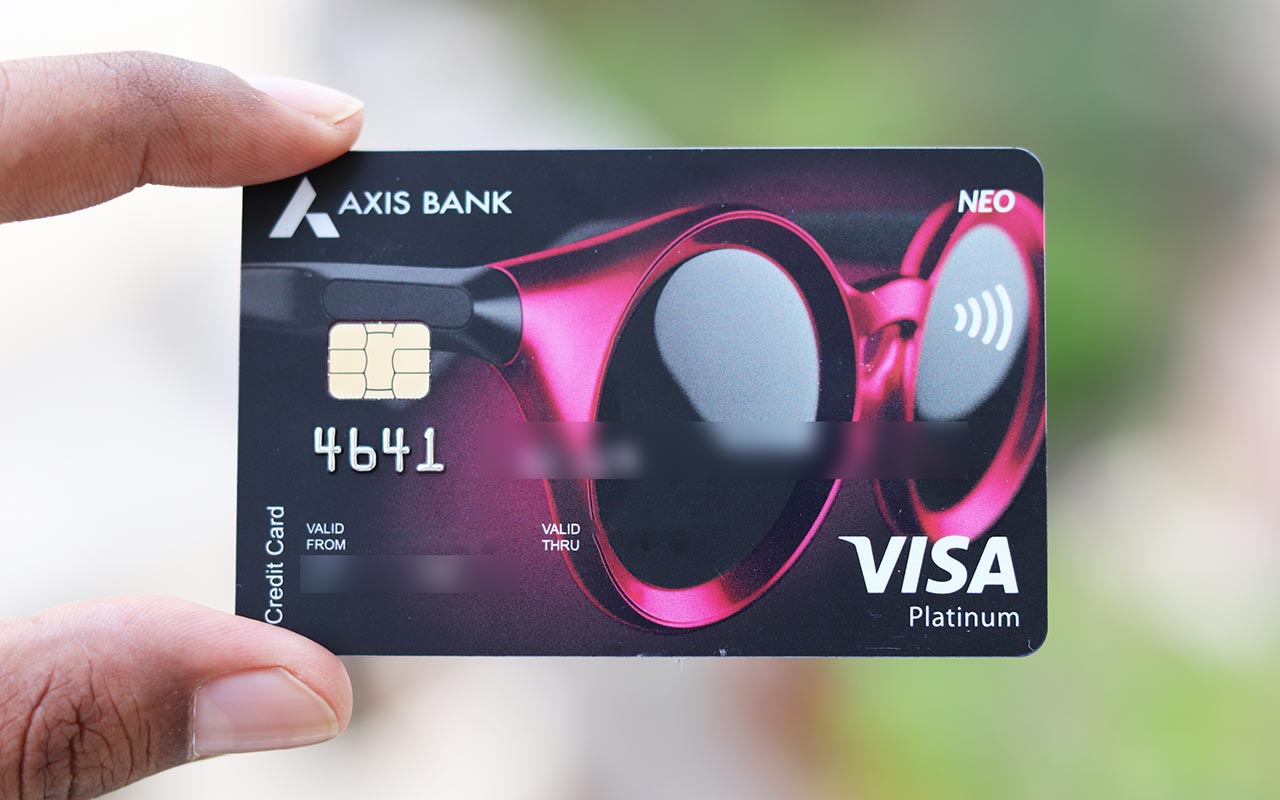
Our catalogue shows how far apart the two layers sit. The Axis Neo RuPay Credit Card and the SBI Cashback Credit Card (a Visa) both charge a 3.5% forex markup. One network is domestic-first, the other global, and the markup is identical, because the markup is the bank's number.
The HDFC Millennia Mastercard shows the same split from the other direction. Its lounge benefit runs under the Mastercard Lounge Program, so the network name is on it. The gate is HDFC's: two complimentary visits per quarter once the previous quarter's spend reaches ₹1 lakh.
Feature, caveat, utility: a network brand tells you which programme exists. The issuer's Most Important Terms and Conditions tell you whether you will ever qualify for it.
Which network is accepted where, in India and abroad?
At home, the difference that matters is UPI, covered below. Abroad, the networks are not equals. Visa describes its acceptance as "tens of millions of locations around the world". Mastercard is also a global network. We found no published terminal count by network for India, so we will not rank them on one.
RuPay's reach abroad is built on partnerships. Its own global page names a tie-up with Discover Financial Services from March 2012, and the RuPay JCB Global Card, launched in July 2019, which works at JCB acceptance points abroad. The page claims RuPay Global cards are accepted at over 42.4 million POS locations and 1.90 million ATMs in 200-plus countries and territories. That page carries no date, and the figure is RuPay's own, so read it as a ceiling.
The caveat: RuPay's page itself tells customers to ask their bank to enable international transactions before travel. A merchant abroad that does not take Discover or JCB will not take your RuPay card either.
Utility: if the next trip is overseas, carry a Visa or Mastercard as the main card and treat a RuPay card as the backup. Forex markup still comes from the issuer, so check that line in the card's terms whatever the logo says.
Can you link a credit card to UPI? Only RuPay, for now
Only RuPay credit cards can be linked to UPI in India. NPCI's own FAQ page says "Currently, only RuPay Credit Card can be linked on UPI", and its operating circular for RuPay credit cards on UPI is dated 4 October 2022. In September 2026, the Department of Financial Services said the NPCI circular on UPI charges "does not allow credit transactions on UPI by any other credit card other than the RuPay credit card", as reported by PTI on 17 September 2026.
For you, that means a RuPay credit card can sit inside a UPI app and pay at QR codes where no card terminal sits. RBI's July 2026 data counts 8,030.48 lakh static UPI QR acceptance points. Not every one of them takes a credit card, but a Visa or Mastercard credit card can use none of them through UPI.
The caveat is rewards. Whether a UPI payment on a credit card earns anything is the issuer's call. The Axis Neo RuPay card earns the 1% base rate on UPI spends, per our catalogue, but exclusion lists differ from card to card. Standard UPI transaction limits also apply to these payments.
Utility: if UPI is where your monthly spending actually goes, a RuPay credit card is the only network that turns it into card spend. The reasons behind RuPay's growth have their own post on this site, so we will not repeat them here.
What do Visa Signature, World Elite and RuPay Select actually add?
Tiers are the network's ladder, and each network names its rungs differently. Visa India lists Classic, Gold, Platinum, Signature and Infinite. Mastercard India lists Standard, World and World Elite. NPCI lists RuPay Classic, Platinum and Select.
Roughly, the top rungs line up as Visa Infinite, World Elite and RuPay Select. That mapping is our reading, not something the networks publish as an equivalence.
What the networks say they supply:
- Visa Infinite: a high credit limit, the Visa Infinite Concierge and personalised privileges.
- Visa Signature: higher spending power, priority customer service and a high level of rewards.
- World Elite Mastercard: Priceless Experiences in over 45 destinations, a 24-hour World Elite Concierge, Zero Liability protection and Mastercard Travel Rewards cashback.
- RuPay: NPCI lists domestic and international lounge access, free personal accident insurance, merchant offers, cashback schemes and health and wellness benefits, with no figures attached.
The caveat is on Mastercard's own page: insurance cover varies by issuer, and benefits vary by issuer for World Mastercard too. Visa's page names no lounge or insurance terms for any tier.
Utility: a tier name is a pointer, not a promise. Open the issuer's terms, find the lounge count, the insurance cover and the spend condition, and judge the card on those.
Visa vs Mastercard vs RuPay: the head-to-head table
Every row below is either set by the network or stated by it. Anything the issuer sets is left out on purpose, because it does not belong to the logo.
| What you are comparing | Visa | Mastercard | RuPay |
|---|---|---|---|
| Who runs it | Global network | Global network | NPCI, India's domestic network |
| Credit card on UPI | No | No | Yes, the only network allowed |
| Acceptance abroad | Own global acceptance | Own global acceptance | Via partners: Discover, JCB |
| Tier ladder | Classic, Gold, Platinum, Signature, Infinite | Standard, World, World Elite | Classic, Platinum, Select |
| Concierge named by the network | Visa Infinite Concierge | World Elite Concierge | Not named on NPCI's page |
| Insurance and lounge terms | Not specified on Visa's page | Vary by issuer | Listed as benefits, no figures |
| Choice at issue (RBI rule, issuers above 10 lakh active cards) | Eligible issuers must offer it | Eligible issuers must offer it | Eligible issuers must offer it |
| Merchant cost (MDR) | No rate published; no RBI cap on credit MDR | No rate published; no RBI cap on credit MDR | Nil MDR up to ₹2,000 on UPI at small offline merchants |
Sources for each row sit at the end of this post. The tier mapping across columns is ours.
Who pays MDR, and does it change anything for you?
The merchant pays MDR, and you never see it. MDR is the merchant discount rate: the fee a shop pays its acquiring bank on each card payment. A part of it, called interchange, goes to the card issuer. RBI's August 2022 discussion paper on charges in payment systems says the payment system operator generally sets interchange.
Debit cards have an RBI cap on MDR, in place since 2012. Credit card MDR was not capped as of that paper, and we found no later cap. That is why we will not quote a percentage for any network. No primary source publishes one.
RuPay credit cards on UPI have a published rule: nil MDR up to and including ₹2,000 at small offline merchants, per NPCI's October 2022 circular. The circular gives no rate for larger payments.
A separate UPI change is on hold. NPCI announced an MDR on select person-to-merchant UPI payments above ₹2,000, due from 15 October 2026. On 13 October it deferred the rollout until after Diwali, saying the new date "will be notified separately", and press reports as of 11 November 2026 show no date yet. Press coverage of NPCI's FAQ says RuPay credit cards linked to UPI are not covered by that framework. We could not open NPCI's FAQ file ourselves, so treat that as reported, not confirmed, and we quote no rate for it.
Utility: MDR does not change your statement. It changes how willing a shop is to take your card, and how much income an issuer earns from it.
Can you choose your card network? What RBI's rule says
Yes, if the issuer is large enough. RBI circular RBI/2023-24/131 of 6 March 2024, titled "Arrangements with Card Networks for issue of Credit Cards", bars issuers from agreements that restrain them from using other networks. It also requires them to give eligible customers a choice of networks when a card is issued (paragraph 3(b)). For existing cardholders, the circular says the option may be provided at the next renewal. The choice requirement took effect six months after the circular, which makes it 6 September 2024.
Two groups sit outside it. Issuers with 10 lakh or fewer active credit cards are exempt. So are issuers that run their own network, with American Express as the usual example.
The caveat is practical. Our reading is that the circular gives you a choice among the networks your issuer already works with. It does not make every card product available on all three. Some programmes sell the same card as separate variants: the IndianOil Axis Bank card exists on both Visa and RuPay in our catalogue. Our separate post on that pair covers which one wins for fuel.
We found no later instrument that withdraws the circular. We read the full text of the November 2025 Commercial Banks credit card Directions: they contain no network-choice provision, and their repeal clause (paragraph 93) names no earlier instrument. We did not check the separate Directions for non-bank issuers. Treat the March 2024 circular as the rule, and ask the issuer in writing.
A simple framework before you ask for a network
Answer one question first: where does your next ₹10,000 of card spend go? The answer picks the network.
- Mostly UPI and neighbourhood QR codes: take a RuPay credit card, since it is the only one that links to UPI.
- Overseas trips, even one a year: take a Visa or Mastercard as the lead card, and check its forex markup in the issuer's terms.
- Premium perks: compare the issuer's lounge and insurance terms, not the tier name.
- Already holding a card you like: ask at renewal. The RBI circular says issuers may offer existing cardholders a choice then, so it is worth asking.
If you hold two cards, one RuPay for UPI and one Visa or Mastercard for travel covers both gaps. If you hold one, pick for the spending you actually do, not the spending you plan to do.
Sources
- Reserve Bank of India, circular RBI/2023-24/131 dated 6 March 2024, "Arrangements with Card Networks for issue of Credit Cards", https://www.rbi.org.in/scripts/NotificationUser.aspx?Id=12619 - source of the bar on exclusivity (paragraph 3(a)), the choice of networks at issue and the optional offer at renewal (3(b)), the exemption for issuers with 10 lakh or fewer active cards (5), the exclusion of issuers on their own network (6), and the six-month effective date (7). Checked 22 November 2026.
- Business Standard, 5 September 2024, https://www.business-standard.com/finance/personal-finance/visa-or-mastercard-from-tomorrow-you-can-choose-your-credit-card-network-124090500187_1.html - source of the 6 September 2024 start date and the American Express example. Checked 22 November 2026.
- Reserve Bank of India, Commercial Banks (Credit Cards and Debit Cards: Issuance and Conduct) Directions, 2025, notification RBI/DOR/2025-26/155 dated 28 November 2025, https://www.rbi.org.in/Scripts/NotificationUser.aspx?Id=13155&Mode=0 - full text read to check whether the network-choice provisions were restated; none found (the only mention of a card network is the insurance clause at paragraph 73). Repeal clause at paragraph 93. Checked 22 November 2026.
- Reserve Bank of India, Payment System Indicators in the RBI Bulletin, https://rbi.org.in/scripts/BS_ViewBulletin.aspx?Id=24498 - source of 12.29 crore credit cards outstanding (July 2026), FY2025-26 credit card spends of ₹23,62,471 crore, and 8,030.48 lakh UPI QR acceptance points (July 2026). The page gives no split by network. Checked 22 November 2026.
- NPCI, Operating circular for RuPay Credit Cards linked to UPI, NPCI/2022-23/RuPay/019 dated 4 October 2022, https://www.npci.org.in/PDF/npci/rupay/2022/Operating-circular-for-RuPay-Credit-Cards-linked-to-UPI.pdf - source of RuPay credit card linkage to UPI and nil MDR up to ₹2,000 at small offline merchants. Checked 22 November 2026.
- NPCI, RuPay product overview, https://www.npci.org.in/what-we-do/rupay/product-overview - source of the RuPay Classic, Platinum and Select tiers and the listed network-level benefits. Checked 22 November 2026.
- RuPay Global, https://rupay.co.in/rupay-advantage/rupay-global - source of the Discover tie-up (March 2012), the RuPay JCB Global Card (July 2019) and RuPay's own acceptance claim of 42.4 million POS and 1.90 million ATM locations in 200-plus countries. The page is undated. Checked 22 November 2026.
- Visa India, credit cards, https://www.visa.co.in/pay-with-visa/find-a-card/credit-cards.html - source of Visa's tier names and tier descriptions, including the Visa Infinite Concierge. Checked 22 November 2026.
- Mastercard India, World Elite Mastercard and World Mastercard, https://www.mastercard.com/in/en/personal/find-a-card/credit-card/world-elite-mastercard.html and https://www.mastercard.com/in/en/personal/find-a-card/credit-card/world-mastercard.html - source of Mastercard's tier names, Priceless Experiences, concierge, Zero Liability, Travel Rewards, and the statement that benefits vary by issuer. Checked 22 November 2026.
- PTI report on a Department of Financial Services statement, 17 September 2026, https://theprint.in/economy/no-us-pressure-in-upi-mdr-decision-npci-circular-offers-no-advantage-to-foreign-credit-cards-finmin/3045344/ - source of the statement that credit transactions on UPI are not allowed for any credit card other than RuPay. Checked 22 November 2026.
- NPCI, RuPay Credit Card on UPI FAQs, https://www.npci.org.in/what-we-do/rupay/rupay-credit-card-on-upi/faqs - source of "Currently, only RuPay Credit Card can be linked on UPI". The page is undated. Checked 22 November 2026.
- The Week, 13 October 2026, https://www.theweek.in/news/biz-tech/2026/10/13/npci-defers-upi-mdr-until-after-diwali.html - source of the deferral of NPCI's UPI MDR on select merchant payments above ₹2,000, with the new date to be notified. Secondary report; NPCI's own notice was not retrieved. Checked 22 November 2026.
- SCC Online, 16 September 2026, https://www.scconline.com/blog/post/2026/09/16/npci-released-upi-mdr-faqs-explained/ - source of the report that RuPay credit cards linked to UPI are not covered by the proposed MDR framework. Secondary report of NPCI's FAQ, written before the deferral; NPCI's FAQ was not retrieved. Checked 22 November 2026.
- Reserve Bank of India, Discussion Paper on Charges in Payment Systems, 17 August 2022, https://www.rbi.org.in/Scripts/PublicationsView.aspx?id=21082 - source of the debit card MDR cap in force since 1 September 2012 (paragraph 7.3), RBI not having intervened on credit card MDR (paragraph 9.3.2), and the definition of interchange as the part of MDR shared with the issuer and set under the payment system operator's rules (paragraph 6.3(ii)). Checked 22 November 2026.
- Card-level figures (forex markup, lounge terms, UPI base rate, variants) come from this site's catalogue: Axis Neo RuPay Credit Card verified 2026-07-02, SBI Cashback Credit Card and HDFC Millennia Credit Card verified 2026-07-13. Checked 22 November 2026.



Frequently asked
What is the difference between Visa, Mastercard and RuPay credit cards?
The network decides where a card works, whether it can link to UPI, and which premium-tier programmes it carries. The issuing bank decides fees, rewards, limits and forex markup. Only RuPay credit cards can be linked to UPI in India. Visa and Mastercard run their own global acceptance, while RuPay abroad relies on partner networks such as Discover and JCB.
Can I use a Visa or Mastercard credit card on UPI?
No. India's Department of Financial Services said in September 2026 that the NPCI circular on UPI charges does not allow credit transactions on UPI by any credit card other than RuPay. Visa and Mastercard credit cards still work at card terminals and on online checkouts, but they cannot be linked to a UPI app as a payment source.
Can I choose between Visa, Mastercard and RuPay when I apply for a credit card?
Often yes. RBI's circular of 6 March 2024 requires issuers with more than 10 lakh active credit cards to offer eligible customers a choice of networks when a card is issued, from 6 September 2024. Existing cardholders may be offered the option at renewal. Issuers running their own network are excluded. The options still depend on which networks that issuer works with.
Is a RuPay credit card accepted abroad?
Partly. RuPay's reach abroad runs through partner networks, including a 2012 tie-up with Discover and the RuPay JCB Global Card launched in July 2019. RuPay's own page claims acceptance in 200-plus countries, though it is undated. Enable international use with your issuer first, and carry a Visa or Mastercard as the primary card abroad.
Who pays MDR on a credit card payment, the customer or the merchant?
The merchant pays MDR to its acquiring bank, and part of it, called interchange, goes to the card issuer. It does not appear on your statement. RBI has capped debit card MDR since 2012, but credit card MDR was not capped as of RBI's August 2022 discussion paper, and we found no later cap.
Card devaluations, reward maths, and rate changes the day they land.
Follow on X
Reader comments
No comments yet. Share your experience with this card below — the first useful comment helps every reader after you.
Comments are moderated before they appear. Share your real experience with a card — what worked, what didn't, what the bank told you. We don't publish promotional content, referral links, or personal financial details. Keep it useful for other readers.