On 2 April 2026, Axis Bank pulled Accor Live Limitless, Marriott Bonvoy and Qatar Airways Privilege Club off its Travel Edge transfer list in one unannounced revision. For an Axis Atlas holder, that single change dropped the best-case return on ordinary spend from roughly 8 percent to about 1 percent. Magnus and Olympus lost their conversion ratios in the same sweep. Here is what Axis took out of Travel Edge, and the little that is still worth using.
What Axis pulled out of Travel Edge
The damage starts with the partner list. Axis removed Accor, Marriott Bonvoy and Qatar Airways, and the Accor exit is the one that hurts.
Accor was the anchor because its points carried a fixed, transparent value: 2,000 Accor ALL points convert to exactly €40 of hotel credit, with no award chart and no dynamic pricing to dodge. Axis had been buying those points in bulk and passing them to cardholders at generous ratios, a 1:2 rate on Atlas and 5:4 on Magnus Burgundy. With the rupee sliding against the euro and disciplined cardholders draining the arbitrage faster than interchange could fund it, the partnership turned into a loss the bank chose to stop absorbing. Cutting Accor did not just remove one redemption option. It deleted the fixed yardstick that every Travel Edge transfer used to be measured against.
The Avios pivot diluted every ratio
To fill the gap, Axis onboarded British Airways Executive Club, Finnair Plus and Vietnam Airlines Lotusmiles. The replacements transfer, but the new ratios are a fraction of what Accor offered, and the cut tracks the card tier almost exactly.
| Axis card | Old ratio (Accor era) | New partner ratio | Effective drop |
|---|---|---|---|
| Axis Atlas | 1 EDGE Mile : 2 points | 2 EDGE Miles : 1 point | ~75% |
| Axis Magnus | 5 EDGE points : 4 | 5 EDGE points : 2 | ~50% |
| Axis Olympus | 1 EDGE Mile : 4 points | 1 EDGE Mile : 2 points | ~50% |
| Axis Horizon | 1 EDGE Mile : 1 point | 2 EDGE Miles : 1 point | ~50% |
| Burgundy Private | 5 EDGE points : 4 | 5 EDGE points : 4 | unchanged |
Burgundy Private is the only card that walked away untouched, keeping its 5:4 rate. That is the pattern across the whole 2026 wave: the ultra-premium tier keeps its economics while the mass-affluent cards most people actually carry absorb the cut.
Group A and Group B throttle what is left
Even the surviving partners come capped. Axis split them into two tiers and put hard annual limits on each, with the tighter limit sitting on exactly the partners worth chasing.
- Group A, the high-demand airlines: Aeroplan, British Airways, Singapore Airlines KrisFlyer, United MileagePlus and Turkish Airlines.
- Group B, the regional and hotel partners: AirAsia, Air India Maharaja Club, ITC, Qantas and Radisson Rewards.
An Atlas holder can move 1,50,000 EDGE Miles a year in total, but only 30,000 of those into Group A. A Magnus holder gets 5,00,000 points overall with a 1,00,000 sub-limit into Group A. These caps do not pool across cards that share a currency, so holding two Axis cards buys no extra Group A room. The design goal is plain: stop mid-tier cardholders from stockpiling enough miles to book the long-haul business-class seats that made these cards aspirational in the first place.
Atlas base spend, before and after
Run the numbers on plain, uncategorised spend and the collapse is stark.
Before April, Atlas paid 2 EDGE Miles per ₹100, and the 1:2 Accor ratio turned that into 4 ALL points worth ₹1.80 to ₹2.10 each, a 7.2 to 8.4 percent return on money you were spending anyway. After the cut, the same ₹100 still earns 2 EDGE Miles, but the best live route, British Airways Avios at 2:1, converts that into a single Avios worth ₹0.80 to ₹1.00. The return lands at 0.8 to 1.0 percent.
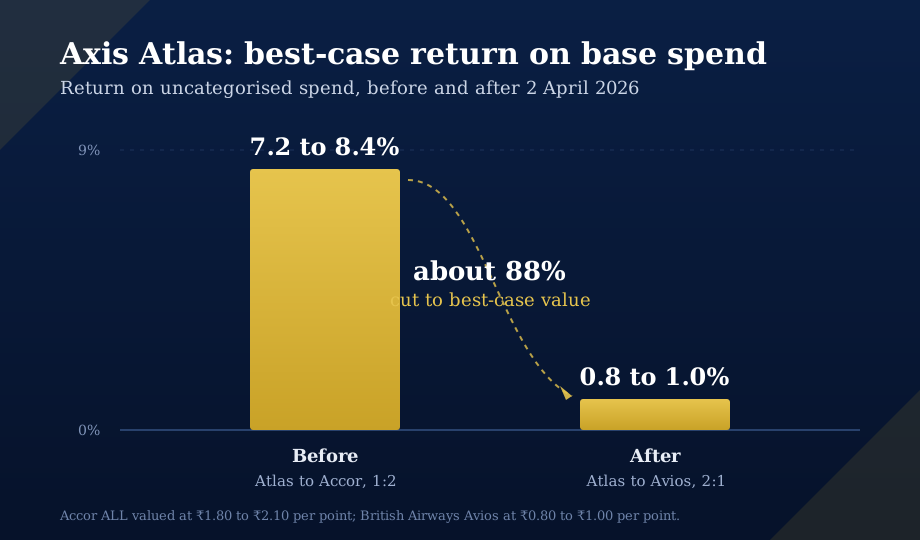
In rupees, an Atlas holder spending ₹10 lakh a year used to generate around ₹85,000 of fairly reliable hotel value. After April 2026 the same spend throws off closer to ₹10,000 in volatile, capacity-restricted airline miles. That is an 88 percent cut to best-case value, the steepest single devaluation in the 2026 round.
Axis Magnus base spend, before and after
Magnus is the card most searches on this devaluation are actually about, and the cut tracks Atlas closely. Magnus earns 12 EDGE Points per Rs 200 of regular spend, 6 per Rs 100. Before April, the 5:4 Accor ratio turned that into 4.8 ALL points worth ₹1.80 to ₹2.10 each, an 8.6 to 10.1 percent return on ordinary spend, the best base-spend yield in the Axis premium lineup. After the cut, the same ₹100 still earns 6 EDGE Points, but the 5:2 ratio into the new partners converts that into about 2.4 Avios worth ₹0.80 to ₹1.00, a 1.9 to 2.4 percent return. That is a 75 to 78 percent cut, in the same range as Atlas.
The one part of Magnus untouched by any of this is the accelerated tier: 35 EDGE Points per Rs 200 (17.5 per Rs 100) on monthly spend above Rs 1.5 lakh in a billing cycle. That rate is a spend-threshold reward, not a transfer-partner conversion, so the April changes do not touch it. For a cardholder who clears the threshold most months, the accelerated tier alone can still justify the Rs 12,500 annual fee even with the transfer arbitrage gone; for one who does not, Magnus now behaves like a mid-pack rewards card wearing a super-premium price tag.
The August 2026 round: DCC and reward exclusions widen
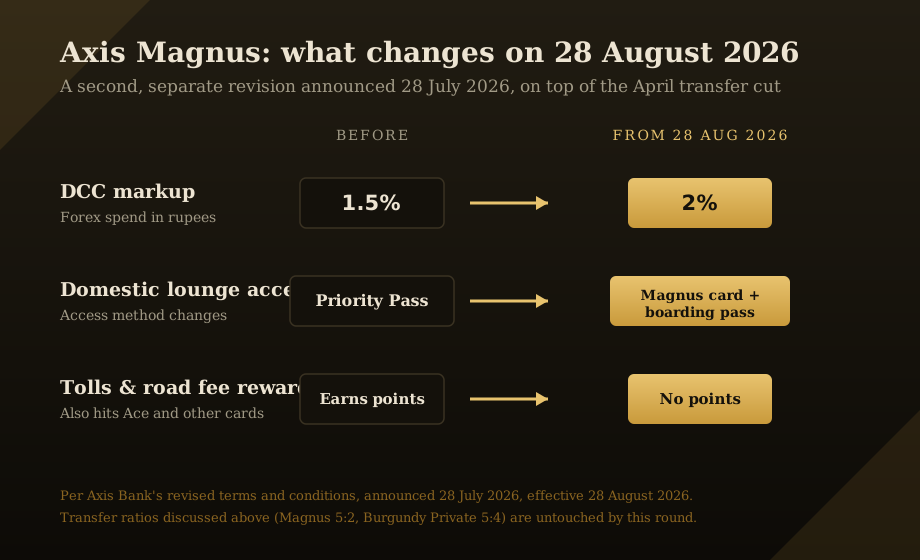
On 28 July 2026, Axis announced a second revision, unrelated to Travel Edge and touching no transfer ratio at all. The changes take effect 28 August 2026, and Magnus sits inside them.
The DCC markup, the fee charged when a foreign-currency transaction settles in rupees, rises from 1.5 percent to 2 percent. Axis Bank's own revised terms and conditions for the related Magnus for Burgundy card spell it out directly: the markup "will be revised to 2% from 1.5%." The same clause extends to the plain Magnus card.
Domestic lounge access changes in mechanism, not in substance. From 28 August, Priority Pass stops working at Indian domestic lounges. Magnus holders keep the visits; they present the physical card and a boarding pass at the counter instead of the Priority Pass. International lounge access via Priority Pass is untouched.
The exclusion with the widest reach: EDGE Points stop accruing on bridge fees, road fees and tolls, and gift-card purchases move into a separate "Gift Card" spend category that still earns nothing. Axis applied this clause bank-wide, not to Magnus alone, and it reaches the Axis Ace named below as a card that came through the April cut clean. Ace's flat cashback rate on ordinary spend is unchanged; toll and gift-card spend on Ace simply stops counting, the same as on Magnus.
Two smaller operational changes round out the round: the payment-adjustment order now applies fees and charges first, then EMIs, then interest, then purchases, then cash advances, and the late fee on outstanding balances of ₹50,000 or more moves to ₹1,300.
None of this touches the transfer ratios discussed above. Magnus still converts EDGE Points to partner miles at 5:2, and Burgundy Private still holds its 5:4 rate.
Which Axis cards still earn after the cut
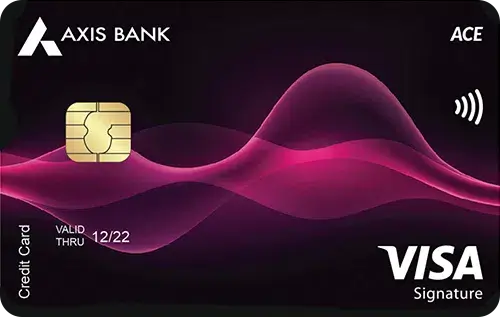
The Axis Magnus is no longer the transfer machine that justified its fee for spenders below the Rs 1.5 lakh monthly threshold. The cards that held up best in April are the ones that never leaned on transfer partners in the first place: the Axis Ace still pays flat cashback on every swipe, and the Axis Flipkart still pays its category rates. Neither April transfer-partner cut touched them.
A narrower cut did reach the Ace in the August round. Axis's bank-wide reward-exclusion clause, the same one revising Magnus, strips EDGE Points from tolls, bridge fees, road fees and gift-card purchases on the Ace from 28 August 2026. Its flat cashback rate on everything else stands; those specific categories just stop counting. For how this slots into the wider picture, our roundup of the 2026 credit card devaluations tracks every issuer that cut inside the same window.
Is an Axis travel card still worth carrying
If you held an Atlas or a Magnus purely for the Accor arbitrage, that reason no longer exists, and the next renewal deserves a real decision rather than an autopilot payment. Map the annual fee against what the card now earns on your actual spend, not the spend you pictured when you applied. Burgundy and Burgundy Private holders keep enough of their economics to stay put. Everyone else is better off routing base spend through a flat-earning card and keeping a premium travel card only when the lounge access and milestone credits clear the fee on their own. Axis has repriced Travel Edge for its own balance sheet. The cardholders who come out ahead are the ones who reprice their wallet to match.
Sources
- Axis Bank: EDGE Miles and points transfer partners
- Axis Bank: Atlas Credit Card
- Axis Bank: press releases
- Axis Bank: revised Magnus for Burgundy terms and conditions, effective 28 August 2026
- Reserve Bank of India: Discussion Paper on Introduction of Expected Credit Loss Framework for Provisioning by Banks


Frequently asked
What did Axis Bank change about Travel Edge in April 2026?
On 2 April 2026 Axis Bank removed Accor, Marriott Bonvoy and Qatar Airways as Travel Edge transfer partners and added British Airways, Finnair and Vietnam Airlines at much weaker ratios. It also capped annual transfers into the high-value Group A airlines, cutting best-case value across the Atlas, Magnus and Olympus cards.
How much did the Axis Atlas devaluation cut its reward value?
On uncategorised spend the Atlas best-case return fell from roughly 7 to 8 percent to about 1 percent after the Accor exit, close to an 88 percent cut. A holder spending ₹10 lakh a year went from around ₹85,000 in hotel value to near ₹10,000 in airline miles.
How did the 2026 devaluation affect the Axis Magnus credit card?
Magnus earns 12 EDGE Points per Rs 200 (6 per Rs 100) on regular spend. Its Accor transfer ratio was cut from 5:4 to 5:2, so best-case value on uncategorised spend fell from roughly 8.5 to 10 percent down to about 2 percent, in the same 75-80 percent range as the Atlas cut. The card still earns 35 EDGE Points per Rs 200 above Rs 1.5 lakh in a billing cycle, which is unaffected by the transfer-partner change and remains the strongest reason to keep the card for high spenders.
Which Axis cards are least affected by the 2026 devaluation?
Cards that never relied on transfer partners held up best. The Axis Ace still pays flat cashback on every spend and the Axis Flipkart keeps its category rates, so neither lost value. Among premium cards, only Burgundy Private kept its old 5:4 transfer ratio.
Is the Axis Atlas still worth holding after April 2026?
Only if the lounge access and milestone flight credits cover the annual fee on their own. The transfer arbitrage that justified the card for many holders is gone, so treat the next renewal as a real decision and avoid paying the fee out of habit.
Did the August 2026 Axis Bank changes affect the Magnus card too?
Yes, separately from the April transfer cut. Effective 28 August 2026, the Magnus DCC markup rises from 1.5 to 2 percent, domestic lounge access needs the physical card instead of Priority Pass, and EDGE Points stop on toll, bridge and road-fee spends. The same reward exclusion also hits the Axis Ace.
Card devaluations, reward maths, and rate changes the day they land.
Follow on X
Reader comments
No comments yet. Share your experience with this card below — the first useful comment helps every reader after you.
Comments are moderated before they appear. Share your real experience with a card — what worked, what didn't, what the bank told you. We don't publish promotional content, referral links, or personal financial details. Keep it useful for other readers.