Scan a QR code with a RuPay credit card linked to UPI and you have used a credit card. Scan the same QR code with a pre-sanctioned credit line linked to UPI and you have taken a drawdown on a loan. The app shows you a balance either way, deducts nothing from your savings account either way, and calls the money available credit either way.

That screen hides one of the sharpest product distinctions in Indian retail banking, and it is the one most explainers get wrong, because the two features arrived within a year of each other and both got called "credit on UPI".
Two products, one payment screen
A RuPay credit card on UPI is a card. The RBI allowed RuPay credit cards to be linked to UPI, which is a large part of why RuPay has been taking credit card share. Linking changes the acceptance surface and nothing else. The account behind the payment is still your card account, the transaction still appears on your card statement, and the card's Most Important Terms and Conditions still govern it.
A credit line on UPI is a loan. In September 2023 the RBI extended UPI's scope to cover pre-sanctioned credit lines at banks, so a bank can sanction you a line and let you draw on it at any QR code, with your prior consent. The circular is explicit that the limit, the tenor, the rate of interest and the repayment terms are set by the bank under its own board-approved policy.
The regulator standardised the rail. It did not standardise the product. Two banks can put lines on UPI that behave nothing like each other, and both are compliant.
Side by side, where the two diverge
| What you are comparing | RuPay credit card on UPI | Credit line on UPI |
|---|---|---|
| The instrument | A credit card account, reached through a QR code | A sanctioned loan facility, drawn at a QR code |
| Rewards | The card's own programme, subject to its exclusions | None, unless the bank has published a scheme for the line |
| Interest-free days | The card's billing cycle plus its grace period | Only if the sanction grants one |
| A disputed merchant payment | Raised with the card issuer against a statement line | Raised with your own bank, then the RBI ombudsman if unresolved |
| On the credit report | A revolving card account with a limit and a utilisation figure | Whatever account type the bank files the line under |
| Where the terms live | The card's MITC and schedule of charges | The sanction letter and the bank's credit policy |
Nothing in that right-hand column is inherently bad. Every entry in it is unknown until you read your own sanction, which is a different relationship with a product than most people have with a card.
The interest-free period is a card feature, not a UPI feature
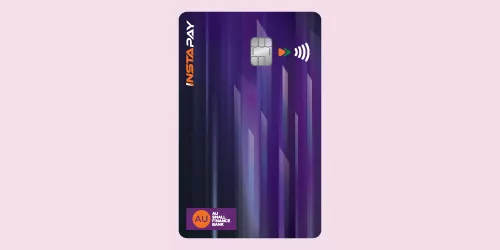
A card gives you days between a purchase and the due date during which the bank charges nothing for the credit. The AU Bank InstaPay, a virtual RuPay card built for UPI and open only to people who already hold an AU Small Finance Bank credit card, states up to 48 days of interest-free credit. That is the bank's own stated figure rather than one we have been able to confirm against its terms document, and either way it comes from the card's billing cycle, not from UPI. Why the advertised maximum reaches only the cycle's first purchase is worth reading on how the billing cycle and grace period really count.
On a credit line the same question has no default answer. Interest may run from the moment of drawdown, or the line may bill on a cycle and behave much like a card. Both designs are permitted. Your sanction letter and the key facts statement given at approval are where the answer sits. If you cannot find either, ask for both before you pay with the line.
Disputes run on a different rail
Unauthorised transactions are the part that does not change. The RBI's customer-liability framework for unauthorised electronic banking transactions applies across electronic channels, so reporting a fraudulent debit promptly protects you whether the money moved from a card, an account or a line.
The gap is in merchant disputes: goods that never arrived, a double charge, a cancelled booking never refunded. A card transaction is disputed with the issuer against an identified line on your statement, under the network's rules. A UPI payment is a push to a merchant's handle, so recourse starts with a complaint to your own bank, and escalates, if the bank does not resolve it, to the RBI's Integrated Ombudsman Scheme. It is a real route. It is slower, narrower, and it has none of the card networks' merchant-dispute machinery behind it.
How it reports, and how you repay
Ask which account type the line reports as. A credit card files with the bureaus as a revolving card account carrying a sanctioned limit, and its utilisation ratio is a large input into your score. A line filed as a loan account reads differently to a future lender, and neither the payment screen nor the app dashboard says which your bank chose. That is worth settling early, given the tighter mis-selling and reporting rules landing in 2027.
Ask what the repayment obligation actually is. A card bills monthly, prints a total and a minimum, and lets you choose between them at a known cost. A line may bill the same way, or amortise into fixed instalments, or demand full repayment inside a set number of days. If it does present a minimum, treat it exactly as you would on a card, because paying only the minimum ends the interest concession on the whole balance wherever that structure is used.
Who a credit line on UPI actually suits
It suits someone whose problem is access, not cost. If a card application will not clear, if the need is short and repayment is genuinely certain, and if the alternative is costlier informal borrowing, a sanctioned line at a regulated bank drawn through a rail you already use is a reasonable instrument. Thin-file borrowers building a first bank relationship sit in the same place.
It suits almost nobody whose problem is rewards, because the line pays nothing. A RuPay card built for the rail does: the Kiwi card, sold to new applicants as YES Bank Klick, AU Bank Kosmo or PNB Kiwi on the same Kiwi-app terms, pays 1.5% on UPI scan-and-pay against a 0.5% base rate, lifetime free, with its Kiwis capped monthly at 1% of the card's credit limit and an exclusion list covering telecom, utilities, jewellery, fuel, rent, insurance, education and government services. That cap and that list are the mechanics to compare, in the same way caps decide what any cashback rate is really worth.
Four answers to get in writing before you switch the line on, whoever you bank with:
- The rate of interest, and the date from which it starts running on a drawdown.
- Whether an interest-free period exists at all, and how it is counted.
- The account type the facility reports as to the credit bureaus.
- The repayment shape: a monthly bill, fixed instalments, or a fixed repayment window.
A bank that answers all four in a document is offering you a product. A bank that answers none of them until the first statement arrives is offering you a surprise.
Sources
- Reserve Bank of India, Operation of Pre-Sanctioned Credit Lines at Banks through Unified Payments Interface, circular dated 4 September 2023. Source of the facility's definition, the prior-customer-consent requirement, and the rule that the limit, tenor, rate of interest and repayment terms are set under each bank's board-approved policy. Checked 6 September 2026.
- Reserve Bank of India, Customer Protection: Limiting Liability of Customers in Unauthorised Electronic Banking Transactions, circular dated 6 July 2017. Source of the point that unauthorised-transaction liability protection applies across electronic banking channels rather than to cards alone. Checked 6 September 2026.
- Reserve Bank of India, Reserve Bank - Integrated Ombudsman Scheme, 2021. Source of the escalation half of the dispute route described above: the ombudsman route available once a complaint made to the bank itself is unresolved. The first half of that route, the complaint to your own bank, follows from the bank being the account provider rather than from any document cited here. Checked 6 September 2026.
- Card-level figures for the Kiwi RuPay Credit Card and the AU Bank InstaPay Credit Card are as recorded in this site's card catalogue. No figures are quoted for any specific bank's credit line on UPI: those terms differ by bank and by borrower, and yours are in your own sanction letter.
Disclosure: this post contains affiliate links. If you apply through them we may earn a commission, at no extra cost to you. Our editorial view is independent of that. #ad
Frequently asked
What is the difference between a credit line on UPI and a RuPay credit card on UPI?
A credit line on UPI is a pre-sanctioned loan facility at your bank that you draw down by paying at a UPI QR code. A RuPay credit card on UPI is an ordinary credit card account that has been linked to a UPI handle, so the payment settles to your card. The payment screen is nearly identical. The product behind it is not: one is a loan account governed by a sanction letter, the other is a card account governed by its Most Important Terms and Conditions.
Do you earn rewards on a credit line on UPI?
Not as a rule. Rewards are a feature of a card programme, and a drawdown on a credit line is not card spend, so nothing earns unless the bank has separately published a reward scheme for that line. A RuPay credit card linked to UPI keeps its own programme, subject to the exclusions in the card terms, which is why UPI-first cards can pay on scan-and-pay while a line pays nothing.
Does a credit line on UPI have an interest-free period?
Only if the sanction grants one. The interest-free period is a feature of a credit card's billing cycle, not of the UPI rail. On a credit line, whether interest begins at drawdown or at the end of a billing period is set by the terms the bank sanctioned to you, and that document is the only place the answer is written.
Can you raise a chargeback on a payment made from a credit line on UPI?
A merchant dispute on a UPI payment is raised with your own bank and, if the bank does not resolve it, escalated under the RBI's Integrated Ombudsman Scheme, 2021. That is a different route from a card chargeback, which is raised with the card issuer against a line on a card statement under the network's rules. Report an unauthorised transaction promptly either way: the RBI's customer-liability framework for unauthorised electronic banking transactions covers both.
Is a credit line on UPI reported to credit bureaus?
Yes, as a credit facility from the bank. What differs is the account type it is filed under, which the bank chooses and which the app screen does not state. A credit card reports as a revolving card account with a sanctioned limit and a utilisation figure. Ask your bank which account type your line reports as before you draw on it.
Card devaluations, reward maths, and rate changes the day they land.
Follow on X
Reader comments
No comments yet. Share your experience with this card below — the first useful comment helps every reader after you.
Comments are moderated before they appear. Share your real experience with a card — what worked, what didn't, what the bank told you. We don't publish promotional content, referral links, or personal financial details. Keep it useful for other readers.